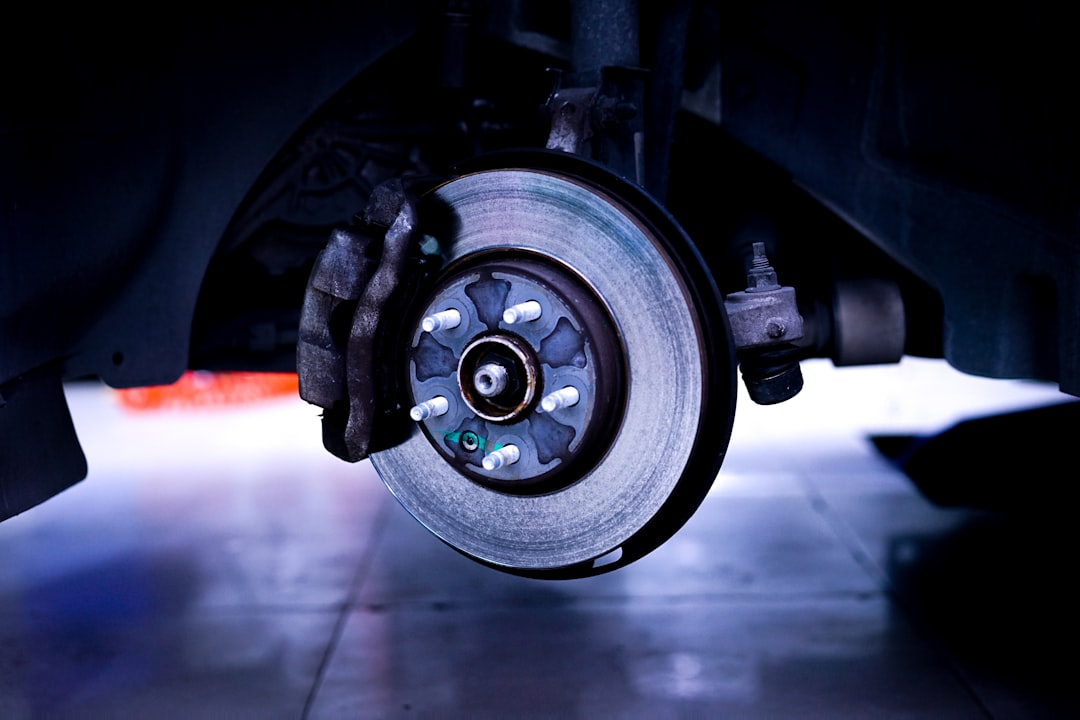
The Camry hauls down clean on surface streets, then somewhere on the Lawrence Expressway approach into Santa Clara a pulse hammers up through the pedal, rhythmic and insistent, every time you shed speed. You checked the pads last month, and they still carry plenty of material. So your first question when you roll into Driven Auto Care of San Jose is what wore out. The pads rarely have, and the rotors usually still have plenty of life left in them too. We pick up a micrometer, walk it around the rotor face at five points, and read the numbers your foot already felt on the freeway.
Disc Thickness Variation: The Complaint a Pad Check Misses
Pulsation in the pedal means the two faces of the rotor have gone out of parallel, so as it spins that high spot shoves back against the pad and fires the pulse straight into your foot. We call it disc thickness variation, and we measure it with a micrometer at several points around the rotor face. The variation a Camry tolerates before it throbs lives in a few thousandths of an inch, and a thumb dragged across that rotor finds nothing wrong. The face looks mirror-smooth and still slams the pedal at every off-ramp.
One Lug Nut and Toyota Bulletin T-SB-0313-17
Here's the detail most shops skip on the XV50 Camry: Toyota bulletin T-SB-0313-17 documents brake vibration on 2015 to 2017 models from a single improperly torqued lug nut. When one lug goes on too tight or too loose, it loads the rotor unevenly and distorts the face enough to set the throb going. It happens after a tire rotation or a quick service where the lugs went on with an impact gun and nobody pulled a torque wrench. This is a separate fault from lateral runout, the rotor's side-to-side wobble, which we check with a dial indicator. Two complaints, two tools, two fixes, and conflating them sends the repair sideways.
Squeal, Inner-Pad Wear, and What the Bleeder Tells Us
A squeal after a pad change traces to the pad compound or to anti-squeal shims left off during the job, and it tells you nothing about pad thickness. Inner-pad-only wear sends a different signal, and we read it as a seized caliper slide pin or a brake hose that has delaminated inside and acts as a one-way valve. Fluid shoves through under pedal pressure but can't bleed back, so the caliper stays clamped and grinds that inboard pad down. We crack the bleeder on that corner, and if the caliper lets go, the hose was trapping the pressure all along. The 2015 Camry runs four-wheel disc brakes with a small drum-in-hat parking brake at the rear, so no rear service drum muddies the read.
What the Micrometer Settles
If your 2015 Camry pulses through the pedal, squeals after a recent pad job, or wears unevenly corner to corner, call us at (408) 295-3786. We put the micrometer and the dial indicator on it, work through the bulletin, and tell you what we found before any part leaves the shelf. Owners in Santa Clara, CA bring their Camrys to Driven Auto Care of San Jose because we name what the tools show. That's how a brake inspection on this car earns its keep.