 A compromised cooling system on the 2AZ-FE can carry a Toyota from normal operating temperature into head-damage territory in the time it takes to climb from downtown Santa Clara up 880 toward Milpitas. The dashboard gauge stays calm during the first half of that trip because the coolant sensor reads the fluid that's still in the block, and the gauge catches up to reality only after the damage has already started. Driven Auto Care of San Jose serves Santa Clara Toyota owners from our San Jose shop, and the urgency of a Toyota coolant leak is the part most drivers underestimate until we explain what's happening inside the engine.
Why The 2AZ-FE 2.4L Is The Engine Everyone Should Know About
Toyota built the 2AZ-FE for the 2002–2009 Camry, 2001–2008 RAV4, and 2004–2010 Scion tC, and the engine earned a documented weak point that Toyota acknowledged through a customer support program. The head bolt threads in the aluminum block pull under years of heat cycling, which lets the head lift a few thousandths of an inch at the failed bolt location. That tiny gap becomes a pathway for coolant to migrate into the combustion chamber, and combustion gases migrate in the other direction into the coolant. The symptoms start as phantom coolant loss with no visible leak, and they end as a warped head if the condition runs long enough without diagnosis.
The 2GR-FE V6 Has A Different Failure With A Faster Timeline
Toyota's 2GR-FE 3.5L V6 powered 2007–2011 Camry, 2005–2012 Avalon, 2006–2012 RX350, and several other models, and the original plastic coolant bypass pipe runs underneath the intake manifold as a crossover tube connecting the two cylinder heads. The plastic cracks from a decade of thermal cycles, and a cracked pipe drops coolant fast because the system pressurizes and forces fluid out in a stream. Toyota released an updated replacement pipe and issued guidance for the failure, and we swap in the updated part whenever we open the intake for any reason on these engines. The timeline from crack to overheat can run shorter than a single commute during summer traffic on 101.
The Diagnostic Most Toyota Shops Skip
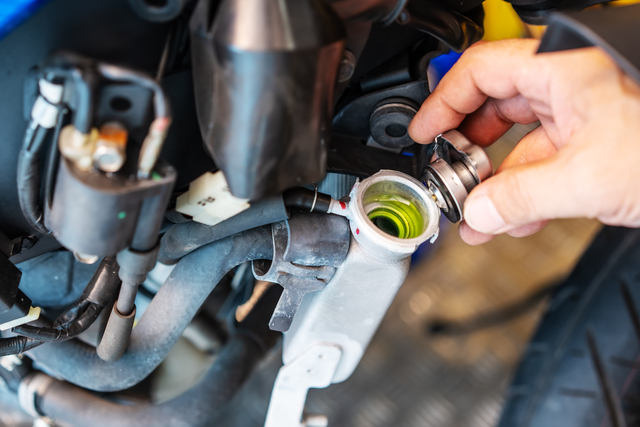
A cooling system pressure test finds external leaks under system load, and a UV dye trace follows them back to the source component. Neither test catches a head gasket or a cracked head the way a chemical block test for combustion gases does. The block test uses a glass tube of blue reagent held over the radiator neck with the engine warm, and the reagent turns yellow when exhaust gases migrate into the coolant. Driven Auto Care of San Jose runs the block test whenever a Toyota's coolant loss has no visible external source, and the result either confirms a head gasket failure or clears the engine and sends us looking elsewhere.
If Your Toyota Is Doing Any Of These Things, Call Us This Week
If your Toyota is losing coolant with nothing visible on the driveway, call Driven Auto Care of San Jose at (408) 295-3786. If your heater is blowing cool air while the gauge reads normal, that's an air pocket from coolant loss, and it needs attention before the pocket migrates somewhere worse. If you smell a faint sweet odor from the engine bay at stoplights, that's coolant cooking on a hot surface, and it means the leak has already started. The sooner we find the source, the more of the original engine we can save for the miles ahead.
A compromised cooling system on the 2AZ-FE can carry a Toyota from normal operating temperature into head-damage territory in the time it takes to climb from downtown Santa Clara up 880 toward Milpitas. The dashboard gauge stays calm during the first half of that trip because the coolant sensor reads the fluid that's still in the block, and the gauge catches up to reality only after the damage has already started. Driven Auto Care of San Jose serves Santa Clara Toyota owners from our San Jose shop, and the urgency of a Toyota coolant leak is the part most drivers underestimate until we explain what's happening inside the engine.
Why The 2AZ-FE 2.4L Is The Engine Everyone Should Know About
Toyota built the 2AZ-FE for the 2002–2009 Camry, 2001–2008 RAV4, and 2004–2010 Scion tC, and the engine earned a documented weak point that Toyota acknowledged through a customer support program. The head bolt threads in the aluminum block pull under years of heat cycling, which lets the head lift a few thousandths of an inch at the failed bolt location. That tiny gap becomes a pathway for coolant to migrate into the combustion chamber, and combustion gases migrate in the other direction into the coolant. The symptoms start as phantom coolant loss with no visible leak, and they end as a warped head if the condition runs long enough without diagnosis.
The 2GR-FE V6 Has A Different Failure With A Faster Timeline
Toyota's 2GR-FE 3.5L V6 powered 2007–2011 Camry, 2005–2012 Avalon, 2006–2012 RX350, and several other models, and the original plastic coolant bypass pipe runs underneath the intake manifold as a crossover tube connecting the two cylinder heads. The plastic cracks from a decade of thermal cycles, and a cracked pipe drops coolant fast because the system pressurizes and forces fluid out in a stream. Toyota released an updated replacement pipe and issued guidance for the failure, and we swap in the updated part whenever we open the intake for any reason on these engines. The timeline from crack to overheat can run shorter than a single commute during summer traffic on 101.
The Diagnostic Most Toyota Shops Skip
A cooling system pressure test finds external leaks under system load, and a UV dye trace follows them back to the source component. Neither test catches a head gasket or a cracked head the way a chemical block test for combustion gases does. The block test uses a glass tube of blue reagent held over the radiator neck with the engine warm, and the reagent turns yellow when exhaust gases migrate into the coolant. Driven Auto Care of San Jose runs the block test whenever a Toyota's coolant loss has no visible external source, and the result either confirms a head gasket failure or clears the engine and sends us looking elsewhere.
If Your Toyota Is Doing Any Of These Things, Call Us This Week
If your Toyota is losing coolant with nothing visible on the driveway, call Driven Auto Care of San Jose at (408) 295-3786. If your heater is blowing cool air while the gauge reads normal, that's an air pocket from coolant loss, and it needs attention before the pocket migrates somewhere worse. If you smell a faint sweet odor from the engine bay at stoplights, that's coolant cooking on a hot surface, and it means the leak has already started. The sooner we find the source, the more of the original engine we can save for the miles ahead.
Santa Clara, CA - Can A Toyota Coolant Leak Cause Engine Overheating Fast?
SYNOPSIS: Driven Auto Care explains how coolant loss in Toyota engines like 2AZ FE and 2GR FE can quickly lead to head damage without early detection. Don't delay repairs for fear of what's causing it and cost.
Toyota Coolant Leaks Move Faster Than You Expect
BY: Arun Coumar, Driven Auto Care of San Jose, CA
A compromised cooling system on the 2AZ-FE can carry a Toyota from normal operating temperature into head-damage territory in the time it takes to climb from downtown Santa Clara up 880 toward Milpitas. The dashboard gauge stays calm during the first half of that trip because the coolant sensor reads the fluid that's still in the block, and the gauge catches up to reality only after the damage has already started. Driven Auto Care of San Jose serves Santa Clara Toyota owners from our San Jose shop, and the urgency of a Toyota coolant leak is the part most drivers underestimate until we explain what's happening inside the engine.
Why The 2AZ-FE 2.4L Is The Engine Everyone Should Know About
Toyota built the 2AZ-FE for the 2002–2009 Camry, 2001–2008 RAV4, and 2004–2010 Scion tC, and the engine earned a documented weak point that Toyota acknowledged through a customer support program. The head bolt threads in the aluminum block pull under years of heat cycling, which lets the head lift a few thousandths of an inch at the failed bolt location. That tiny gap becomes a pathway for coolant to migrate into the combustion chamber, and combustion gases migrate in the other direction into the coolant. The symptoms start as phantom coolant loss with no visible leak, and they end as a warped head if the condition runs long enough without diagnosis.
The 2GR-FE V6 Has A Different Failure With A Faster Timeline
Toyota's 2GR-FE 3.5L V6 powered 2007–2011 Camry, 2005–2012 Avalon, 2006–2012 RX350, and several other models, and the original plastic coolant bypass pipe runs underneath the intake manifold as a crossover tube connecting the two cylinder heads. The plastic cracks from a decade of thermal cycles, and a cracked pipe drops coolant fast because the system pressurizes and forces fluid out in a stream. Toyota released an updated replacement pipe and issued guidance for the failure, and we swap in the updated part whenever we open the intake for any reason on these engines. The timeline from crack to overheat can run shorter than a single commute during summer traffic on 101.
The Diagnostic Most Toyota Shops Skip
A cooling system pressure test finds external leaks under system load, and a UV dye trace follows them back to the source component. Neither test catches a head gasket or a cracked head the way a chemical block test for combustion gases does. The block test uses a glass tube of blue reagent held over the radiator neck with the engine warm, and the reagent turns yellow when exhaust gases migrate into the coolant. Driven Auto Care of San Jose runs the block test whenever a Toyota's coolant loss has no visible external source, and the result either confirms a head gasket failure or clears the engine and sends us looking elsewhere.
If Your Toyota Is Doing Any Of These Things, Call Us This Week
If your Toyota is losing coolant with nothing visible on the driveway, call Driven Auto Care of San Jose at (408) 295-3786. If your heater is blowing cool air while the gauge reads normal, that's an air pocket from coolant loss, and it needs attention before the pocket migrates somewhere worse. If you smell a faint sweet odor from the engine bay at stoplights, that's coolant cooking on a hot surface, and it means the leak has already started. The sooner we find the source, the more of the original engine we can save for the miles ahead.