 Three years of climbing repair invoices on a commercial roof in Fort Myers tells a story most building owners try to ignore. Each patch buys another few months, each emergency call after a summer storm adds another line to the maintenance ledger, and the membrane that looked fine from the parking lot keeps letting heat and moisture find new paths into the structure. At some point, the math flips. The money you're spending to maintain an aging system exceeds what a planned upgrade would cost over the same period, and the building keeps getting hotter while you wait for the next leak to prove it.
We see this pattern on commercial properties across Fort Myers, and the turning point is rarely a dramatic blowout. It's the quiet accumulation of repair costs, rising energy bills from HVAC systems fighting rooftop heat, and an insurance premium trend that penalizes older assemblies. The question isn't whether the membrane will eventually fail across the field. The question is whether you'll make the switch on your terms or on the storm's.
Where the Crossover Point Hides
Most building owners expect a roofer to say "your roof is old, you need a new one." We'd rather show you the numbers. The crossover point between continued membrane repairs and a metal roofing upgrade isn't driven by age alone; it's driven by three converging signals. Your repair frequency is increasing, meaning the same failure zones keep returning because the substrate beneath the membrane is holding moisture that each patch seals over without addressing. Your energy costs are rising, because a dark membrane roof on a Fort Myers commercial building can hit 150 degrees or more by early afternoon, and that thermal load pushes straight down through insulation and into your HVAC system for hours. Your insurance carrier is tightening terms on older roof assemblies, and each year without an upgrade narrows your coverage window.
What Reflective Metal Changes in the Thermal Equation
A dark commercial membrane acts as a solar sponge from the moment the sun clears the treeline in Fort Myers. That stored heat doesn't leave when the clouds roll in for the afternoon thunderstorm; it radiates downward through every layer beneath it, stressing adhesives, softening flashings, and forcing your cooling system into cycles it was never sized to sustain. Standing seam metal with a reflective Kynar PVDF finish drops that surface temperature dramatically, and the building starts shedding heat instead of storing it. Adhesives last longer when they aren't baking under a dark surface all day. Flashing sealants hold their bond when the roof deck beneath them isn't cycling through extreme temperature swings. Your HVAC equipment sits on a cooler deck plate and runs fewer hours to hold the same interior temperature.
Why the Panel Fabrication Method Matters
Standing seam metal panels can be manufactured off-site and shipped in predetermined lengths, or they can be formed on your property using a portable roll-forming brake. We fabricate panels on-site because every field seam between pre-cut sections becomes a potential failure point under the thermal expansion and wind uplift conditions that define Fort Myers roofing. A continuous panel formed at your building eliminates those mid-run joints and gives the system fewer weak spots for wind-driven rain to exploit during hurricane season. Before any panel goes down, we take moisture readings across the existing deck to determine whether the substrate can support the new assembly or needs replacement. Attaching a metal system to a deck that's holding moisture above 18% is a temporary fix on a compromised foundation.
The Code and Insurance Angle You Should Run First
Florida's Building Code requires that metal panel roof systems meet wind uplift standards tested under UL 580, ASTM E1592, or TAS 125, and every component in the assembly needs Florida Product Approval documentation. F.S. 553.844 mandates wind mitigation upgrades on reroofing projects, which means the permit itself triggers structural requirements that change your scope of work. The upside for commercial building owners in Fort Myers is that these code-mandated upgrades can qualify your property for insurance premium reductions through a completed wind mitigation inspection. The roof you thought was a cost line becomes a recovery instrument when you plan the upgrade with the full code and insurance picture on the table.
Salt Air, Coating Systems, and the 40-Year Horizon
Fort Myers salt air corrodes metal finishes that weren't engineered for coastal exposure, and a cheap panel finish can chalk, fade, and lose its protective bond within a decade. Kynar PVDF resin-based coatings were built for exactly this environment; the fluoropolymer chemistry resists UV degradation, salt corrosion, and chalking across a service life that typically runs 40 years or longer with proper installation. We specify Kynar-finished panels on every commercial metal project in Fort Myers because the coating system is where the long-term value lives or dies. A standing seam roof with a substandard finish in a salt air environment is a 15-year roof sold as a 40-year roof, and the difference only shows up after you've already paid for both.
Your Maintenance Ledger Already Has the Answer
If the repair costs on your Fort Myers commercial roof have been climbing for two or three consecutive years, the data is pointing you toward a decision that gets more expensive the longer you wait. Call PRG Roofing & Construction Inc. at (239) 237-2906 for a commercial metal upgrade assessment that puts your current maintenance spend, your energy costs, and your insurance position side by side with the standing seam option so you can see exactly where the crossover lives.
Three years of climbing repair invoices on a commercial roof in Fort Myers tells a story most building owners try to ignore. Each patch buys another few months, each emergency call after a summer storm adds another line to the maintenance ledger, and the membrane that looked fine from the parking lot keeps letting heat and moisture find new paths into the structure. At some point, the math flips. The money you're spending to maintain an aging system exceeds what a planned upgrade would cost over the same period, and the building keeps getting hotter while you wait for the next leak to prove it.
We see this pattern on commercial properties across Fort Myers, and the turning point is rarely a dramatic blowout. It's the quiet accumulation of repair costs, rising energy bills from HVAC systems fighting rooftop heat, and an insurance premium trend that penalizes older assemblies. The question isn't whether the membrane will eventually fail across the field. The question is whether you'll make the switch on your terms or on the storm's.
Where the Crossover Point Hides
Most building owners expect a roofer to say "your roof is old, you need a new one." We'd rather show you the numbers. The crossover point between continued membrane repairs and a metal roofing upgrade isn't driven by age alone; it's driven by three converging signals. Your repair frequency is increasing, meaning the same failure zones keep returning because the substrate beneath the membrane is holding moisture that each patch seals over without addressing. Your energy costs are rising, because a dark membrane roof on a Fort Myers commercial building can hit 150 degrees or more by early afternoon, and that thermal load pushes straight down through insulation and into your HVAC system for hours. Your insurance carrier is tightening terms on older roof assemblies, and each year without an upgrade narrows your coverage window.
What Reflective Metal Changes in the Thermal Equation
A dark commercial membrane acts as a solar sponge from the moment the sun clears the treeline in Fort Myers. That stored heat doesn't leave when the clouds roll in for the afternoon thunderstorm; it radiates downward through every layer beneath it, stressing adhesives, softening flashings, and forcing your cooling system into cycles it was never sized to sustain. Standing seam metal with a reflective Kynar PVDF finish drops that surface temperature dramatically, and the building starts shedding heat instead of storing it. Adhesives last longer when they aren't baking under a dark surface all day. Flashing sealants hold their bond when the roof deck beneath them isn't cycling through extreme temperature swings. Your HVAC equipment sits on a cooler deck plate and runs fewer hours to hold the same interior temperature.
Why the Panel Fabrication Method Matters
Standing seam metal panels can be manufactured off-site and shipped in predetermined lengths, or they can be formed on your property using a portable roll-forming brake. We fabricate panels on-site because every field seam between pre-cut sections becomes a potential failure point under the thermal expansion and wind uplift conditions that define Fort Myers roofing. A continuous panel formed at your building eliminates those mid-run joints and gives the system fewer weak spots for wind-driven rain to exploit during hurricane season. Before any panel goes down, we take moisture readings across the existing deck to determine whether the substrate can support the new assembly or needs replacement. Attaching a metal system to a deck that's holding moisture above 18% is a temporary fix on a compromised foundation.
The Code and Insurance Angle You Should Run First
Florida's Building Code requires that metal panel roof systems meet wind uplift standards tested under UL 580, ASTM E1592, or TAS 125, and every component in the assembly needs Florida Product Approval documentation. F.S. 553.844 mandates wind mitigation upgrades on reroofing projects, which means the permit itself triggers structural requirements that change your scope of work. The upside for commercial building owners in Fort Myers is that these code-mandated upgrades can qualify your property for insurance premium reductions through a completed wind mitigation inspection. The roof you thought was a cost line becomes a recovery instrument when you plan the upgrade with the full code and insurance picture on the table.
Salt Air, Coating Systems, and the 40-Year Horizon
Fort Myers salt air corrodes metal finishes that weren't engineered for coastal exposure, and a cheap panel finish can chalk, fade, and lose its protective bond within a decade. Kynar PVDF resin-based coatings were built for exactly this environment; the fluoropolymer chemistry resists UV degradation, salt corrosion, and chalking across a service life that typically runs 40 years or longer with proper installation. We specify Kynar-finished panels on every commercial metal project in Fort Myers because the coating system is where the long-term value lives or dies. A standing seam roof with a substandard finish in a salt air environment is a 15-year roof sold as a 40-year roof, and the difference only shows up after you've already paid for both.
Your Maintenance Ledger Already Has the Answer
If the repair costs on your Fort Myers commercial roof have been climbing for two or three consecutive years, the data is pointing you toward a decision that gets more expensive the longer you wait. Call PRG Roofing & Construction Inc. at (239) 237-2906 for a commercial metal upgrade assessment that puts your current maintenance spend, your energy costs, and your insurance position side by side with the standing seam option so you can see exactly where the crossover lives.
Fort Myers, FL - When Commercial Roofers Recommend Metal Roofing Upgrades
SYNOPSIS: PRG Roofing & Construction helps Fort Myers commercial properties evaluate metal roofing upgrades built for Gulf Coast wind loads, salt exposure, and long-term performance.
BY: Randy Garand, PRG Roofing & Construction Inc.
Three years of climbing repair invoices on a commercial roof in Fort Myers tells a story most building owners try to ignore. Each patch buys another few months, each emergency call after a summer storm adds another line to the maintenance ledger, and the membrane that looked fine from the parking lot keeps letting heat and moisture find new paths into the structure. At some point, the math flips. The money you're spending to maintain an aging system exceeds what a planned upgrade would cost over the same period, and the building keeps getting hotter while you wait for the next leak to prove it.
We see this pattern on commercial properties across Fort Myers, and the turning point is rarely a dramatic blowout. It's the quiet accumulation of repair costs, rising energy bills from HVAC systems fighting rooftop heat, and an insurance premium trend that penalizes older assemblies. The question isn't whether the membrane will eventually fail across the field. The question is whether you'll make the switch on your terms or on the storm's.
Where the Crossover Point Hides
Most building owners expect a roofer to say "your roof is old, you need a new one." We'd rather show you the numbers. The crossover point between continued membrane repairs and a metal roofing upgrade isn't driven by age alone; it's driven by three converging signals. Your repair frequency is increasing, meaning the same failure zones keep returning because the substrate beneath the membrane is holding moisture that each patch seals over without addressing. Your energy costs are rising, because a dark membrane roof on a Fort Myers commercial building can hit 150 degrees or more by early afternoon, and that thermal load pushes straight down through insulation and into your HVAC system for hours. Your insurance carrier is tightening terms on older roof assemblies, and each year without an upgrade narrows your coverage window.
What Reflective Metal Changes in the Thermal Equation
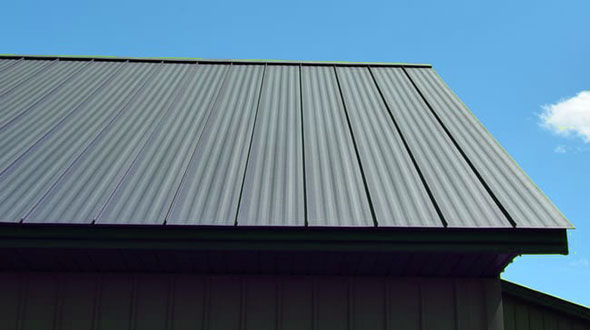
A dark commercial membrane acts as a solar sponge from the moment the sun clears the treeline in Fort Myers. That stored heat doesn't leave when the clouds roll in for the afternoon thunderstorm; it radiates downward through every layer beneath it, stressing adhesives, softening flashings, and forcing your cooling system into cycles it was never sized to sustain. Standing seam metal with a reflective Kynar PVDF finish drops that surface temperature dramatically, and the building starts shedding heat instead of storing it. Adhesives last longer when they aren't baking under a dark surface all day. Flashing sealants hold their bond when the roof deck beneath them isn't cycling through extreme temperature swings. Your HVAC equipment sits on a cooler deck plate and runs fewer hours to hold the same interior temperature.
Why the Panel Fabrication Method Matters
Standing seam metal panels can be manufactured off-site and shipped in predetermined lengths, or they can be formed on your property using a portable roll-forming brake. We fabricate panels on-site because every field seam between pre-cut sections becomes a potential failure point under the thermal expansion and wind uplift conditions that define Fort Myers roofing. A continuous panel formed at your building eliminates those mid-run joints and gives the system fewer weak spots for wind-driven rain to exploit during hurricane season. Before any panel goes down, we take moisture readings across the existing deck to determine whether the substrate can support the new assembly or needs replacement. Attaching a metal system to a deck that's holding moisture above 18% is a temporary fix on a compromised foundation.
The Code and Insurance Angle You Should Run First
Florida's Building Code requires that metal panel roof systems meet wind uplift standards tested under UL 580, ASTM E1592, or TAS 125, and every component in the assembly needs Florida Product Approval documentation. F.S. 553.844 mandates wind mitigation upgrades on reroofing projects, which means the permit itself triggers structural requirements that change your scope of work. The upside for commercial building owners in Fort Myers is that these code-mandated upgrades can qualify your property for insurance premium reductions through a completed wind mitigation inspection. The roof you thought was a cost line becomes a recovery instrument when you plan the upgrade with the full code and insurance picture on the table.
Salt Air, Coating Systems, and the 40-Year Horizon
Fort Myers salt air corrodes metal finishes that weren't engineered for coastal exposure, and a cheap panel finish can chalk, fade, and lose its protective bond within a decade. Kynar PVDF resin-based coatings were built for exactly this environment; the fluoropolymer chemistry resists UV degradation, salt corrosion, and chalking across a service life that typically runs 40 years or longer with proper installation. We specify Kynar-finished panels on every commercial metal project in Fort Myers because the coating system is where the long-term value lives or dies. A standing seam roof with a substandard finish in a salt air environment is a 15-year roof sold as a 40-year roof, and the difference only shows up after you've already paid for both.
Your Maintenance Ledger Already Has the Answer
If the repair costs on your Fort Myers commercial roof have been climbing for two or three consecutive years, the data is pointing you toward a decision that gets more expensive the longer you wait. Call PRG Roofing & Construction Inc. at (239) 237-2906 for a commercial metal upgrade assessment that puts your current maintenance spend, your energy costs, and your insurance position side by side with the standing seam option so you can see exactly where the crossover lives.