 A shredded school banner hanging from a fence in Carlsbad is the result of failed engineering, not just a bad storm. For any school district administrator or facilities manager, that torn vinyl represents a wasted budget and a poor reflection of the institution. We approach every banner project as the manufacturing of a durable outdoor asset; it’s a piece of equipment that must perform reliably for its intended service life.
What Does a Failed Banner Feel Like?
When we get our hands on a competitor's banner that has failed, our diagnosis starts with the material itself. A low-grade vinyl feels thin, almost brittle. If you flex it, you can sometimes hear a faint crinkling sound because it lacks the heavy, pliable feel of a true 13-ounce per square yard scrim material. A quality banner's strength comes from its internal polyester mesh, a fabric with a tight 500x500 denier weave that you can't see but can definitely feel in its substantial weight and resistance to tearing.
Next, we inspect the grommets. Cheap, steel-plated eyelets will show rust streaks bleeding down the banner’s face after the first rain. They are an immediate indicator of cut corners. A correctly specified #2 brass grommet is about a half-inch in diameter and feels solid. You shouldn't be able to wiggle it loose; if you can pull one out and it reveals a ragged, unsupported tear, it means the vinyl was never reinforced to handle the load.
Are Your Banner Hems Causing the Damage?
The single greatest point of failure for an outdoor banner is its edge. That one-inch hem is what carries the entire wind load, and its construction determines if it survives a seasonal Santa Ana wind. That’s why we use heat-welded hems exclusively for outdoor applications. Our equipment applies precise heat and pressure to physically melt the vinyl's edge to itself. This process creates a molecular bond that is fundamentally stronger than the material it's holding together.
A sewn hem, in contrast, punches thousands of tiny holes along the banner's most stressed area. It’s a perfect perforated line that essentially tells the wind exactly where to begin tearing. Banner tape is even worse, as its adhesive will eventually break down under the sun and heat, causing the hem to peel open and fail.
How Can We Guarantee Your School Colors Stay True?
Vibrant graphics are useless if they fade to a pastel blur in a few months. Long-term color stability comes down to ink chemistry and proper file preparation. We require high-resolution files, at least 150dpi at full size and set to a CMYK color profile, to ensure crisp, accurate results. We then print using UV-curable inks that are bonded to the vinyl surface with ultraviolet light. This creates a tough, fade-resistant finish that won't peel or crack. For outdoor use, we always specify a matte finish. A gloss vinyl might look punchy indoors, but in the Carlsbad sun, it creates a mirror-like glare that makes the banner unreadable from an angle.
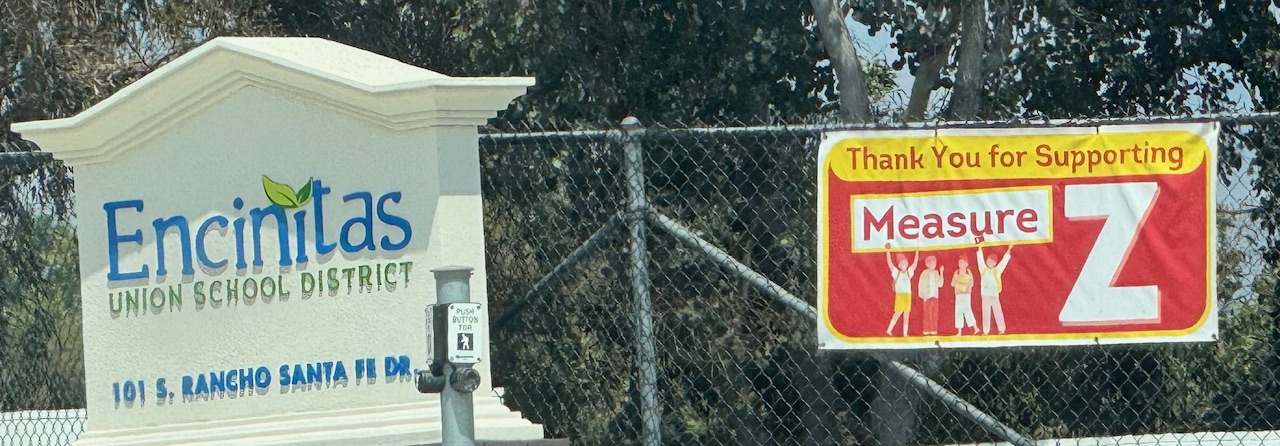
Our recent project for the Encinitas Unified School District is a clear example. We produced 13 banners, each 60 by 30 inches, designed for placement around the city. Every banner was printed on 13oz scrim vinyl and finished with one-inch heat-welded hems. We installed #2 brass grommets every 24 inches on the top and bottom to distribute wind load evenly, preventing the stress points that lead to tearing. This wasn't just printing signs; it was engineering a reliable communication tool for the district.
Your district's budget requires signage that performs as a long-term asset. Investing in the right materials and construction from the start eliminates the recurring cost and hassle of replacing failed banners. If you’re ready to install banners that represent your school with professionalism all year long, let’s talk strategy. Call North Coast Signs, and we'll build a signage plan that works.
A shredded school banner hanging from a fence in Carlsbad is the result of failed engineering, not just a bad storm. For any school district administrator or facilities manager, that torn vinyl represents a wasted budget and a poor reflection of the institution. We approach every banner project as the manufacturing of a durable outdoor asset; it’s a piece of equipment that must perform reliably for its intended service life.
What Does a Failed Banner Feel Like?
When we get our hands on a competitor's banner that has failed, our diagnosis starts with the material itself. A low-grade vinyl feels thin, almost brittle. If you flex it, you can sometimes hear a faint crinkling sound because it lacks the heavy, pliable feel of a true 13-ounce per square yard scrim material. A quality banner's strength comes from its internal polyester mesh, a fabric with a tight 500x500 denier weave that you can't see but can definitely feel in its substantial weight and resistance to tearing.
Next, we inspect the grommets. Cheap, steel-plated eyelets will show rust streaks bleeding down the banner’s face after the first rain. They are an immediate indicator of cut corners. A correctly specified #2 brass grommet is about a half-inch in diameter and feels solid. You shouldn't be able to wiggle it loose; if you can pull one out and it reveals a ragged, unsupported tear, it means the vinyl was never reinforced to handle the load.
Are Your Banner Hems Causing the Damage?
The single greatest point of failure for an outdoor banner is its edge. That one-inch hem is what carries the entire wind load, and its construction determines if it survives a seasonal Santa Ana wind. That’s why we use heat-welded hems exclusively for outdoor applications. Our equipment applies precise heat and pressure to physically melt the vinyl's edge to itself. This process creates a molecular bond that is fundamentally stronger than the material it's holding together.
A sewn hem, in contrast, punches thousands of tiny holes along the banner's most stressed area. It’s a perfect perforated line that essentially tells the wind exactly where to begin tearing. Banner tape is even worse, as its adhesive will eventually break down under the sun and heat, causing the hem to peel open and fail.
How Can We Guarantee Your School Colors Stay True?
Vibrant graphics are useless if they fade to a pastel blur in a few months. Long-term color stability comes down to ink chemistry and proper file preparation. We require high-resolution files, at least 150dpi at full size and set to a CMYK color profile, to ensure crisp, accurate results. We then print using UV-curable inks that are bonded to the vinyl surface with ultraviolet light. This creates a tough, fade-resistant finish that won't peel or crack. For outdoor use, we always specify a matte finish. A gloss vinyl might look punchy indoors, but in the Carlsbad sun, it creates a mirror-like glare that makes the banner unreadable from an angle.
Our recent project for the Encinitas Unified School District is a clear example. We produced 13 banners, each 60 by 30 inches, designed for placement around the city. Every banner was printed on 13oz scrim vinyl and finished with one-inch heat-welded hems. We installed #2 brass grommets every 24 inches on the top and bottom to distribute wind load evenly, preventing the stress points that lead to tearing. This wasn't just printing signs; it was engineering a reliable communication tool for the district.
Your district's budget requires signage that performs as a long-term asset. Investing in the right materials and construction from the start eliminates the recurring cost and hassle of replacing failed banners. If you’re ready to install banners that represent your school with professionalism all year long, let’s talk strategy. Call North Coast Signs, and we'll build a signage plan that works.
Carlsbad, CA - Custom Vinyl Banners for School District from a Sign Company
SYNOPSIS: At North Coast Signs located in Vista, we see firsthand why your school banners in Carlsbad don't last. We're breaking down the material science behind a durable school banner.
Why Your School Banners Fail Before Fall Break
BY: ,
A shredded school banner hanging from a fence in Carlsbad is the result of failed engineering, not just a bad storm. For any school district administrator or facilities manager, that torn vinyl represents a wasted budget and a poor reflection of the institution. We approach every banner project as the manufacturing of a durable outdoor asset; it’s a piece of equipment that must perform reliably for its intended service life.
What Does a Failed Banner Feel Like?
When we get our hands on a competitor's banner that has failed, our diagnosis starts with the material itself. A low-grade vinyl feels thin, almost brittle. If you flex it, you can sometimes hear a faint crinkling sound because it lacks the heavy, pliable feel of a true 13-ounce per square yard scrim material. A quality banner's strength comes from its internal polyester mesh, a fabric with a tight 500x500 denier weave that you can't see but can definitely feel in its substantial weight and resistance to tearing.
Next, we inspect the grommets. Cheap, steel-plated eyelets will show rust streaks bleeding down the banner’s face after the first rain. They are an immediate indicator of cut corners. A correctly specified #2 brass grommet is about a half-inch in diameter and feels solid. You shouldn't be able to wiggle it loose; if you can pull one out and it reveals a ragged, unsupported tear, it means the vinyl was never reinforced to handle the load.
Are Your Banner Hems Causing the Damage?
The single greatest point of failure for an outdoor banner is its edge. That one-inch hem is what carries the entire wind load, and its construction determines if it survives a seasonal Santa Ana wind. That’s why we use heat-welded hems exclusively for outdoor applications. Our equipment applies precise heat and pressure to physically melt the vinyl's edge to itself. This process creates a molecular bond that is fundamentally stronger than the material it's holding together.
A sewn hem, in contrast, punches thousands of tiny holes along the banner's most stressed area. It’s a perfect perforated line that essentially tells the wind exactly where to begin tearing. Banner tape is even worse, as its adhesive will eventually break down under the sun and heat, causing the hem to peel open and fail.
How Can We Guarantee Your School Colors Stay True?
Vibrant graphics are useless if they fade to a pastel blur in a few months. Long-term color stability comes down to ink chemistry and proper file preparation. We require high-resolution files, at least 150dpi at full size and set to a CMYK color profile, to ensure crisp, accurate results. We then print using UV-curable inks that are bonded to the vinyl surface with ultraviolet light. This creates a tough, fade-resistant finish that won't peel or crack. For outdoor use, we always specify a matte finish. A gloss vinyl might look punchy indoors, but in the Carlsbad sun, it creates a mirror-like glare that makes the banner unreadable from an angle.
Our recent project for the Encinitas Unified School District is a clear example. We produced 13 banners, each 60 by 30 inches, designed for placement around the city. Every banner was printed on 13oz scrim vinyl and finished with one-inch heat-welded hems. We installed #2 brass grommets every 24 inches on the top and bottom to distribute wind load evenly, preventing the stress points that lead to tearing. This wasn't just printing signs; it was engineering a reliable communication tool for the district.
Your district's budget requires signage that performs as a long-term asset. Investing in the right materials and construction from the start eliminates the recurring cost and hassle of replacing failed banners. If you’re ready to install banners that represent your school with professionalism all year long, let’s talk strategy. Call North Coast Signs, and we'll build a signage plan that works.