 An evacuation map is a legal document first and a sign second. For business owners in Carlsbad, understanding this distinction is the difference between passing a fire marshal inspection and receiving a costly citation. We often see well-intentioned but non-compliant maps made from office paper in plastic frames. These signs fail because they cannot perform their single required function: providing clear, durable, and accurate directions during a high-stress emergency. An effective evac map is a professionally engineered safety device.
What's the First Thing a Fire Marshal Looks For?
An experienced fire marshal can identify a non-compliant sign from the doorway. The immediate failure point is almost always material durability. A paper map yellows and grows brittle from UV exposure within months. Ambient moisture causes ink to bleed, obscuring critical egress routes. These are not minor cosmetic issues; they represent the complete functional collapse of a life-safety system.
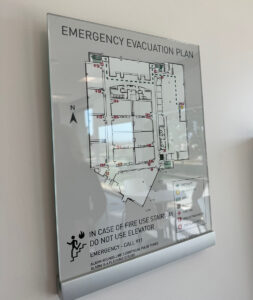
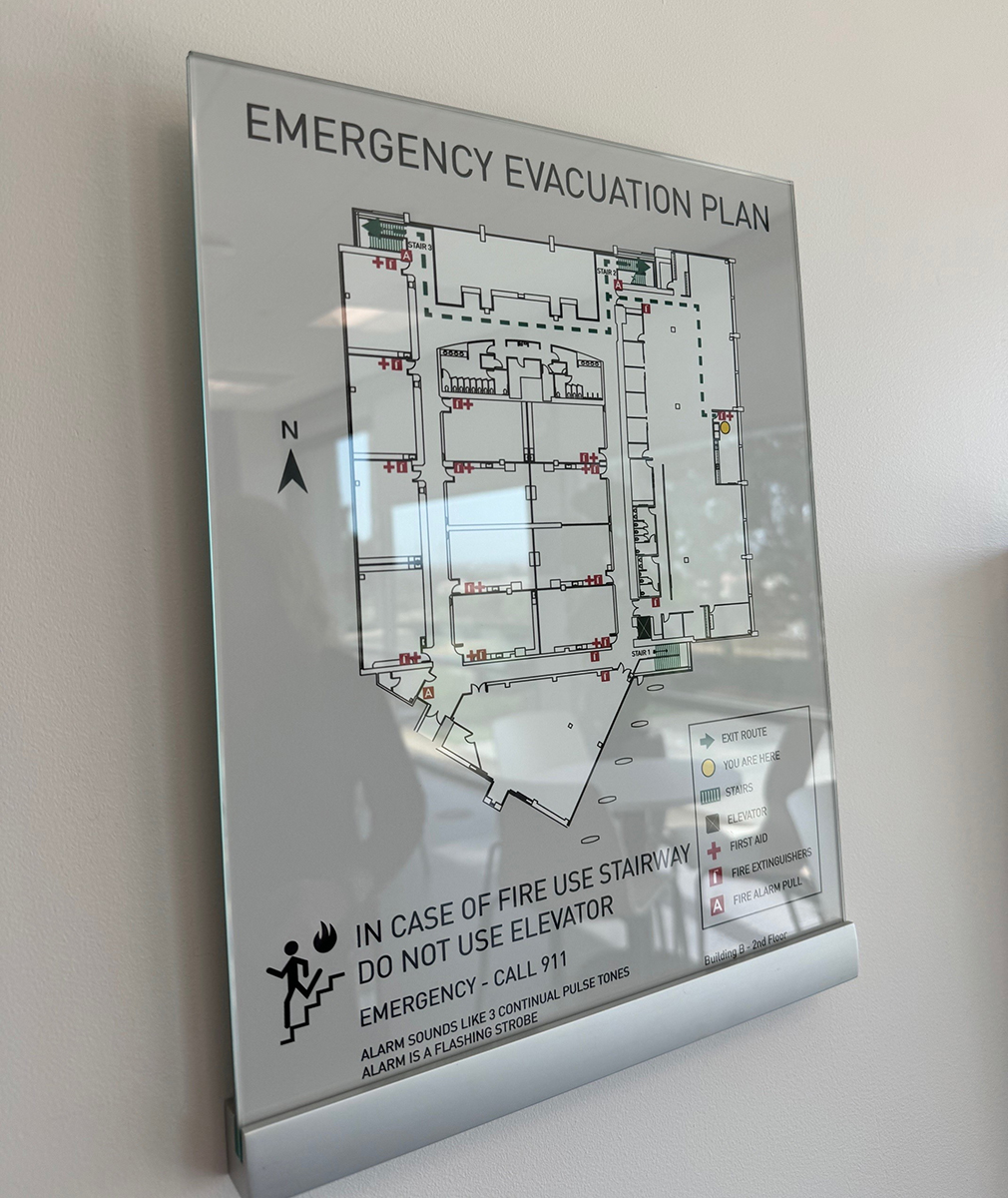
That’s why our process starts with materials specified for permanence. We construct each 10"h x 14"w map by sandwiching the graphic between two panels of 3/16-inch thick tempered glass. This safety glass is roughly four times stronger than standard plate glass. If it breaks, it crumbles into small, granular pieces instead of sharp shards, a safety feature you can verify by finding the manufacturer’s permanent mark etched into a corner of each pane. The map itself is printed on Synaps 8mil polyester, a synthetic paper that is completely waterproof and tear-proof. The final assembly feels solid and substantial, mounted securely to the wall with brushed aluminum brackets and finished with smooth, bullnosed edges for safety.
Why Does My Building Need Multiple Maps for the Same Floor?
The most critical design error we correct is improper map orientation. An evacuation map must be aligned with the direction the viewer is facing. A map on a north-facing wall should be oriented with "north" at the top of the page, but a map for the exact same floor plan on a west-facing wall must be rotated so "west" is at the top. This is a non-negotiable requirement from every Authority Having Jurisdiction (AHJ) we work with.
During an emergency, a person’s ability to perform complex mental rotation is severely compromised. A disoriented map can send occupants deeper into a building instead of toward an exit. For a recent project on a second floor in Carlsbad, we produced six individual maps for the same floor plan. Each had a unique "You are Here" marker on a light grey background and was rotated to match its specific installation point near a stairwell or elevator bank. This removes any dangerous guesswork when seconds are critical.
How Do We Guarantee Our Maps Pass Inspection?
Achieving compliance is a methodical process that begins before any design work is started. Step one is always consulting the local Carlsbad fire marshal for their specific requirements, which often include unique graphic elements on top of the base California Fire Code. These maps are a visual extension of your building’s Emergency Action Plan (EAP), a document legally mandated for any facility with 11 or more employees.
Our job is to translate complex architectural floor plans into clean, unambiguous diagrams. We strip out unnecessary details, use high-contrast colors, and employ bold, sans-serif typography like Helvetica Bold for instant readability. We clearly mark primary and secondary egress routes, pinpoint the location of fire extinguishers and alarm pull stations, and show the path to the designated outdoor assembly area. By engineering the sign to meet the strictest local standard from the outset, we make the final inspection a simple confirmation. Your building's safety plan is too important for materials that degrade or designs that confuse.
An evacuation map is a legal document first and a sign second. For business owners in Carlsbad, understanding this distinction is the difference between passing a fire marshal inspection and receiving a costly citation. We often see well-intentioned but non-compliant maps made from office paper in plastic frames. These signs fail because they cannot perform their single required function: providing clear, durable, and accurate directions during a high-stress emergency. An effective evac map is a professionally engineered safety device.
What's the First Thing a Fire Marshal Looks For?
An experienced fire marshal can identify a non-compliant sign from the doorway. The immediate failure point is almost always material durability. A paper map yellows and grows brittle from UV exposure within months. Ambient moisture causes ink to bleed, obscuring critical egress routes. These are not minor cosmetic issues; they represent the complete functional collapse of a life-safety system.
That’s why our process starts with materials specified for permanence. We construct each 10"h x 14"w map by sandwiching the graphic between two panels of 3/16-inch thick tempered glass. This safety glass is roughly four times stronger than standard plate glass. If it breaks, it crumbles into small, granular pieces instead of sharp shards, a safety feature you can verify by finding the manufacturer’s permanent mark etched into a corner of each pane. The map itself is printed on Synaps 8mil polyester, a synthetic paper that is completely waterproof and tear-proof. The final assembly feels solid and substantial, mounted securely to the wall with brushed aluminum brackets and finished with smooth, bullnosed edges for safety.
Why Does My Building Need Multiple Maps for the Same Floor?
The most critical design error we correct is improper map orientation. An evacuation map must be aligned with the direction the viewer is facing. A map on a north-facing wall should be oriented with "north" at the top of the page, but a map for the exact same floor plan on a west-facing wall must be rotated so "west" is at the top. This is a non-negotiable requirement from every Authority Having Jurisdiction (AHJ) we work with.
During an emergency, a person’s ability to perform complex mental rotation is severely compromised. A disoriented map can send occupants deeper into a building instead of toward an exit. For a recent project on a second floor in Carlsbad, we produced six individual maps for the same floor plan. Each had a unique "You are Here" marker on a light grey background and was rotated to match its specific installation point near a stairwell or elevator bank. This removes any dangerous guesswork when seconds are critical.
How Do We Guarantee Our Maps Pass Inspection?
Achieving compliance is a methodical process that begins before any design work is started. Step one is always consulting the local Carlsbad fire marshal for their specific requirements, which often include unique graphic elements on top of the base California Fire Code. These maps are a visual extension of your building’s Emergency Action Plan (EAP), a document legally mandated for any facility with 11 or more employees.
Our job is to translate complex architectural floor plans into clean, unambiguous diagrams. We strip out unnecessary details, use high-contrast colors, and employ bold, sans-serif typography like Helvetica Bold for instant readability. We clearly mark primary and secondary egress routes, pinpoint the location of fire extinguishers and alarm pull stations, and show the path to the designated outdoor assembly area. By engineering the sign to meet the strictest local standard from the outset, we make the final inspection a simple confirmation. Your building's safety plan is too important for materials that degrade or designs that confuse.
Carlsbad, CA - Sign Company Installs Custom EVAC Maps for Local Business
SYNOPSIS: For Carlsbad businesses, a failed fire inspection is a serious liability. North Coast Signs, in nearby Vista, fabricates and installs code-compliant evacuation maps using tempered glass.
Why You Need A Code-Compliant Evacuation Map
BY: ,
An evacuation map is a legal document first and a sign second. For business owners in Carlsbad, understanding this distinction is the difference between passing a fire marshal inspection and receiving a costly citation. We often see well-intentioned but non-compliant maps made from office paper in plastic frames. These signs fail because they cannot perform their single required function: providing clear, durable, and accurate directions during a high-stress emergency. An effective evac map is a professionally engineered safety device.
What's the First Thing a Fire Marshal Looks For?
An experienced fire marshal can identify a non-compliant sign from the doorway. The immediate failure point is almost always material durability. A paper map yellows and grows brittle from UV exposure within months. Ambient moisture causes ink to bleed, obscuring critical egress routes. These are not minor cosmetic issues; they represent the complete functional collapse of a life-safety system.
That’s why our process starts with materials specified for permanence. We construct each 10"h x 14"w map by sandwiching the graphic between two panels of 3/16-inch thick tempered glass. This safety glass is roughly four times stronger than standard plate glass. If it breaks, it crumbles into small, granular pieces instead of sharp shards, a safety feature you can verify by finding the manufacturer’s permanent mark etched into a corner of each pane. The map itself is printed on Synaps 8mil polyester, a synthetic paper that is completely waterproof and tear-proof. The final assembly feels solid and substantial, mounted securely to the wall with brushed aluminum brackets and finished with smooth, bullnosed edges for safety.
Why Does My Building Need Multiple Maps for the Same Floor?
The most critical design error we correct is improper map orientation. An evacuation map must be aligned with the direction the viewer is facing. A map on a north-facing wall should be oriented with "north" at the top of the page, but a map for the exact same floor plan on a west-facing wall must be rotated so "west" is at the top. This is a non-negotiable requirement from every Authority Having Jurisdiction (AHJ) we work with.
During an emergency, a person’s ability to perform complex mental rotation is severely compromised. A disoriented map can send occupants deeper into a building instead of toward an exit. For a recent project on a second floor in Carlsbad, we produced six individual maps for the same floor plan. Each had a unique "You are Here" marker on a light grey background and was rotated to match its specific installation point near a stairwell or elevator bank. This removes any dangerous guesswork when seconds are critical.
How Do We Guarantee Our Maps Pass Inspection?
Achieving compliance is a methodical process that begins before any design work is started. Step one is always consulting the local Carlsbad fire marshal for their specific requirements, which often include unique graphic elements on top of the base California Fire Code. These maps are a visual extension of your building’s Emergency Action Plan (EAP), a document legally mandated for any facility with 11 or more employees.
Our job is to translate complex architectural floor plans into clean, unambiguous diagrams. We strip out unnecessary details, use high-contrast colors, and employ bold, sans-serif typography like Helvetica Bold for instant readability. We clearly mark primary and secondary egress routes, pinpoint the location of fire extinguishers and alarm pull stations, and show the path to the designated outdoor assembly area. By engineering the sign to meet the strictest local standard from the outset, we make the final inspection a simple confirmation. Your building's safety plan is too important for materials that degrade or designs that confuse.