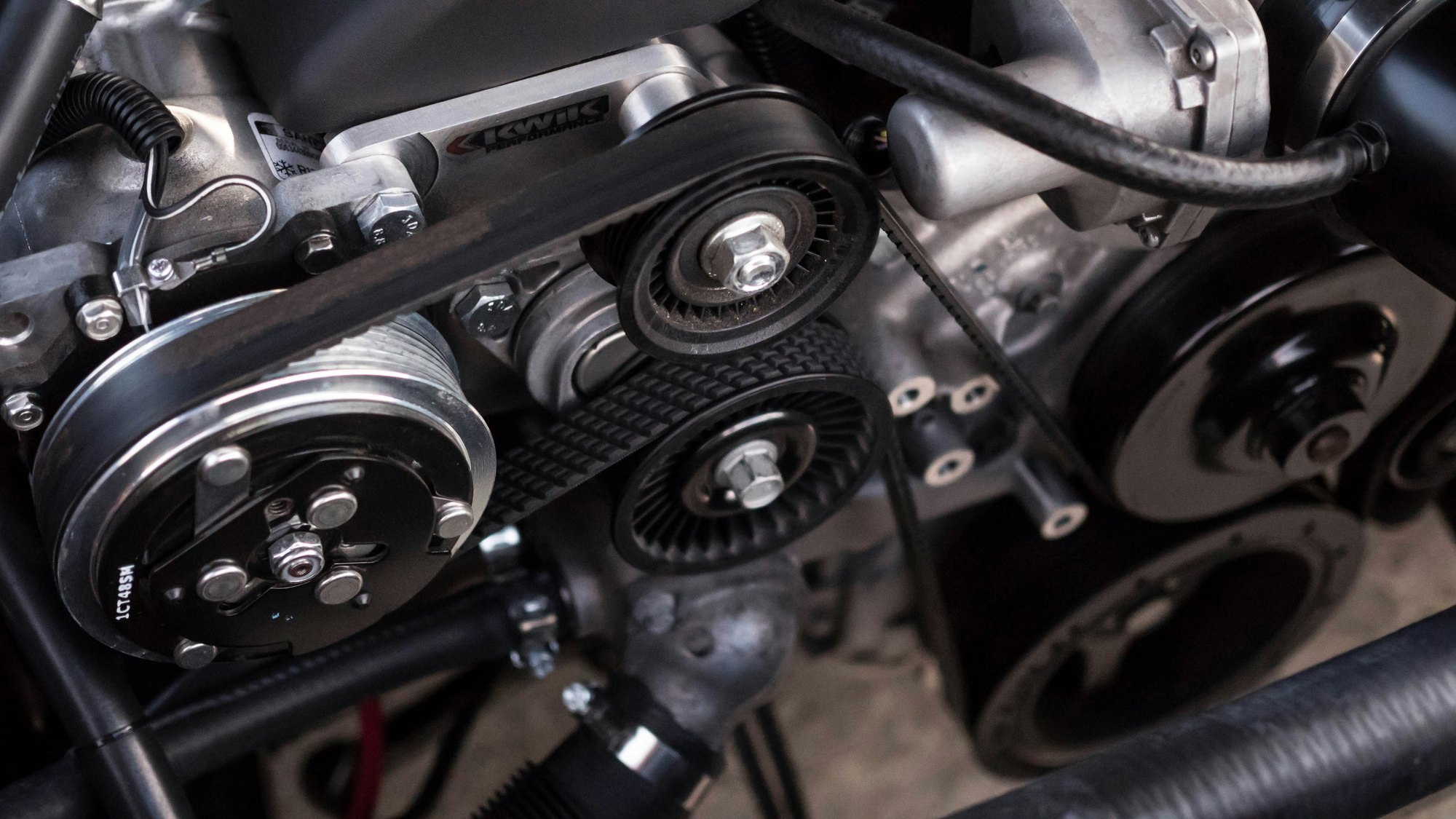
On a cold Danville morning, your Mercedes-Benz C-Class starts with a short chirp that fades within a minute or so. That sound comes from the serpentine belt, the long ribbed belt that drives the alternator and the air conditioning compressor. Cold rubber is stiffer, so a belt with worn ribs or a tensioner with a weak spring lets the belt slip briefly on the pulleys. Once the rubber warms up, the belt grips again and the chirp stops. At Driven Auto Care of San Ramon, we measure the belt and test the tensioner, since both faults sound the same.
Why a C-Class Belt Can Look New and Still Slip
The belt on a C-Class is made from a rubber called EPDM, and EPDM rarely cracks as it ages. Belts from earlier decades were neoprene, and they showed wear as cracks across the ribs. An EPDM belt wears the way a tire wears its tread. The V-shaped ribs on the underside lose rubber a little at a time and round off toward a U shape. As the ribs get shorter, the belt sits deeper in each pulley groove and loses the wedge that keeps it gripping. A small loss of rib height is enough to let the belt slip under load while its outer face still looks smooth.
How Rib Wear Is Measured
Rib wear is measured with a belt wear gauge, a small tool shaped to fit the grooves of a new belt. On a belt with good rib height, the gauge sits snug on top of the ribs. On a worn belt, the gauge drops down into the grooves and rocks from side to side, and that belt is ready to replace. We also look at the underside for a shiny, glazed surface, which forms when a belt has been slipping on its pulleys. Oil or coolant on the belt makes EPDM swell and slip as well, so we follow any wet patch back to the leak.
What the Tensioner Does and How It Wears
The tensioner is a spring-loaded arm with a pulley on the end that presses on the belt and keeps it tight while the engine runs. Over the miles, its spring weakens and the damper inside it wears, so the arm bounces and the belt flutters at idle. A worn pivot lets the pulley lean, and the belt then rides off center and wears along one edge. That bouncing arm also shakes the alternator and the A/C compressor, and an alternator that has worn out early is a reason we look closely at the tensioner. With the engine running, we watch the arm for bounce and the belt for flutter. Once the engine is off, we swing the arm through its travel by hand and spin each pulley to feel for a rough bearing. A rough tensioner or idler bearing can squeal on a cold start even with a brand-new belt in place, so we check the pulleys along with the belt.
Replacing the Belt and Tensioner Together
The tensioner and the idler pulleys wear over the same miles as the belt. When our testing shows wear on them, we replace them in the same visit as the belt. The new belt then runs on pulleys that spin smoothly, pressed by a tensioner with its full spring tension. If the belt breaks while you drive, the alternator stops charging and the air conditioning stops. Pull over where it's safe, shut the engine down and arrange a tow.
Booking a Belt and Tensioner Check
Call Driven Auto Care of San Ramon at (925) 830-4701 about the chirp at a cold start. When you bring the car in, we'll measure the belt ribs and test the tensioner and each pulley. We replace the parts that show wear, and your C-Class starts without the chirp.