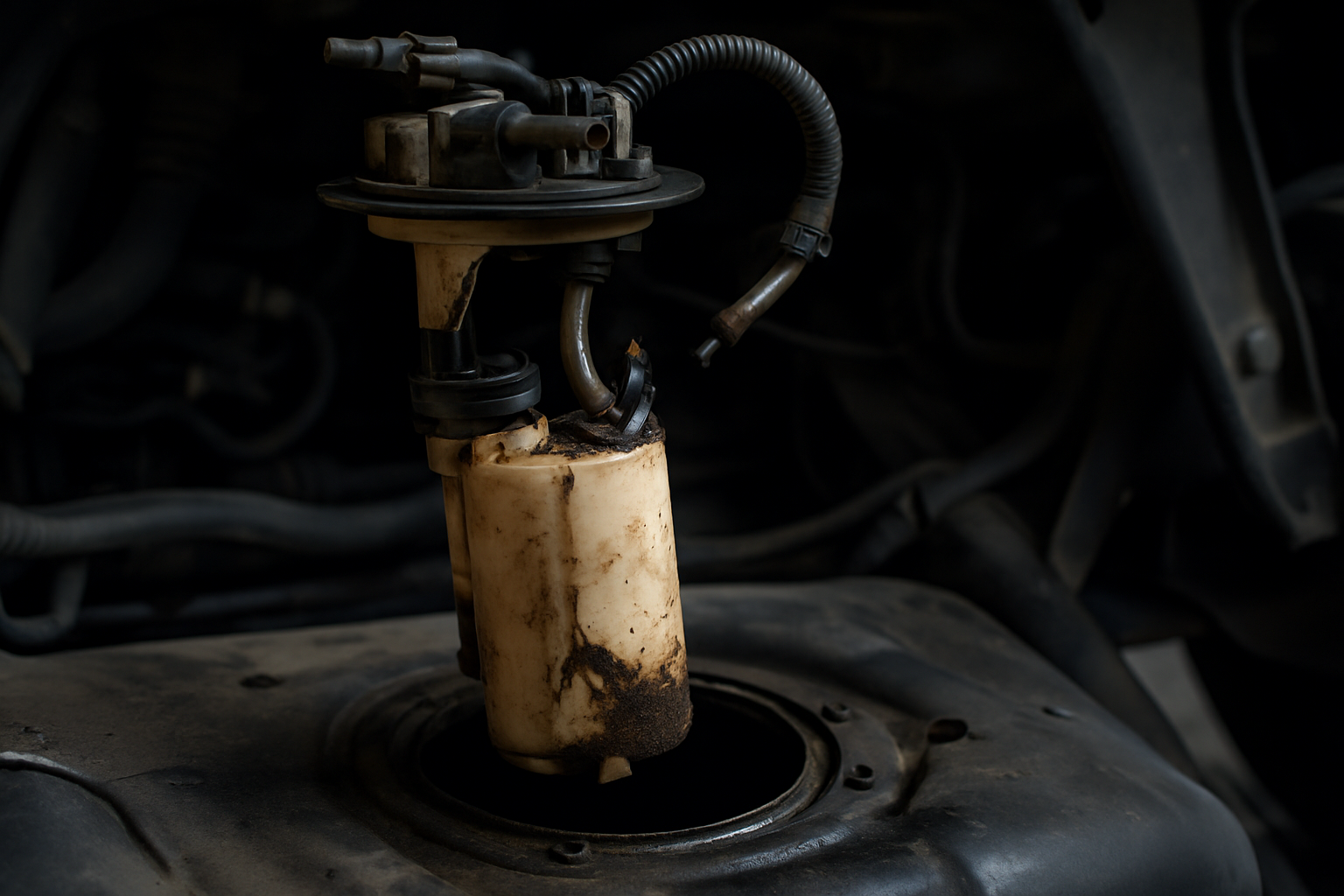
"It cranks and cranks before it starts." If that is how you would describe your Silverado, and it also bogs down when you tow or climb a grade, one likely cause is the electric pump inside the fuel tank. A weak in-tank pump shows up as hard starting and power loss under load. The truck feels fine around town and only falls flat with weight behind it. That pattern fits a pump that still moves fuel but can no longer keep up.
On a 2007-2018 Silverado 1500 pickup that pump comes out through the top of the tank, and the tank sits under the bed, so the repair means lowering the tank or lifting the bed off. Newer trucks carry a second pump on the engine, so which end of the truck comes apart depends on which pump has fallen behind. We find which pump has fallen behind on those trucks by comparing the rail pressure the engine computer is set to hold with the rail pressure we measure.
Two Pumps on the Newer Trucks
A 1999-2013 Silverado with a gasoline V8 is port injected and runs on one electric pump inside the tank. From the 2014 model year, the Silverado 1500's gasoline V6 and V8 engines are direct injected, spraying fuel straight into each cylinder at very high pressure. On those trucks the tank pump sends fuel forward to a second, high-pressure pump on the engine, driven off the camshaft. That engine pump raises the fuel to injection pressure and feeds the fuel rail that supplies the injectors. So a 2014-and-later 1500 with the V6 or V8 has two pumps that could be the cause. That is why the model year comes first in our diagnosis.
The Pump Inside the Tank
Trouble from a weak tank pump shows up when the truck needs the most fuel, such as pulling a trailer or climbing a grade. At a steady cruise a tired pump keeps up, but on a grade with a load the engine needs far more fuel each second, and the pump falls short. The engine stumbles or goes flat, then recovers once the load comes off. Starting suffers too, with a long crank before the engine catches. Fuel pressure that bleeds down in the line overnight can also show up as a long crank the next morning. If the truck stalls or loses power in traffic, stop where it is safe and have it towed in.
The Pump on the Engine
With direct injection, a leaking high-pressure pump can let gasoline into the engine oil, and that oil can smell of fuel. On the 2018 Silverado 1500 with the V6 or V8, a worn lifter under that pump can bring a misfire and a tapping noise at idle. With the AUTEL scan tool connected, we see the rail pressure the engine computer is set to hold beside the rail pressure the high-pressure pump is making. Rail pressure sitting close to the low-side pressure from the tank pump is a sign the high-pressure pump is not building pressure. A faulty rail pressure sensor can look like a failed pump on the scan data, so the sensor reading has to be confirmed before the pump is blamed.
Taking Each Pump Out
With the tank lowered or the bed off, the top of the tank is clear, and the old module lifts out through the opening in its top. On a 1999-2013 truck this is the only pump job, since that truck runs on the tank pump alone. For the 2014 Silverado 1500 with the 5.3L V8, replacing the high-pressure pump on the engine means removing the intake manifold, and the high-pressure fuel pipe comes off with the pump and a new pipe goes in.
Silverado Fuel Pump Repair in San Leandro
You leave with the readings that placed the fault and the repair those readings support, whichever end of the truck it turned out to be. Bring your Silverado to Precision Auto Care in San Leandro, or call (510) 351-8211 to book the diagnosis. We are open Monday through Friday, 8 a.m. to 6 p.m.