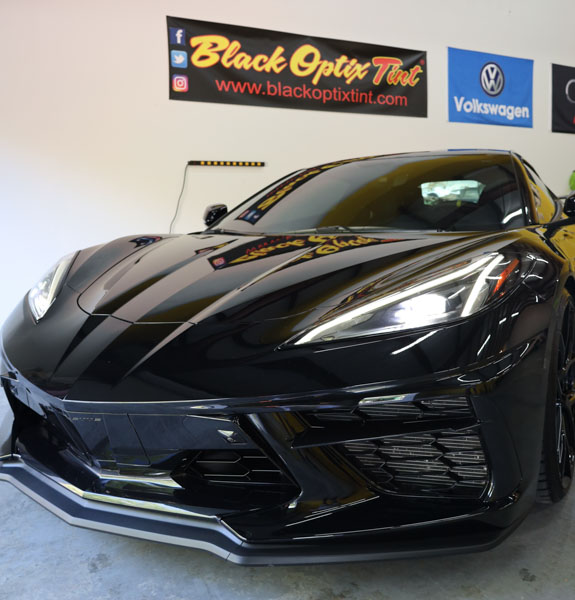
 Park a dark-colored car in any Fort Myers lot in August and the dashboard will read close to 150 degrees by the time you get back to it. The steering wheel turns into something you brace for. That heat is exactly what ceramic film is built to push back against, and it's the reason this question lands in our shop more than any other we hear at Black Optix Tint.
What Florida Sun Does To Everything Behind The Glass
Sustained ultraviolet exposure dries leather, cracks vinyl, fades fabric, and ages plastic surfaces faster than most owners expect. Heat shortens the working life of infotainment screens, cabin sensors, and battery cells in newer vehicles. Premium ceramic film blocks 99% of ultraviolet rays across treated glass, including across the windshield. The interior you protect this year is the interior you don't end up apologizing for at trade-in.
What's Inside A Ceramic Film
Quality ceramic window film is a polyester base with ceramic nanoparticles embedded throughout, finished with a scratch-resistant top coat that handles cleaning and daily use. The nanoparticles reject infrared radiation, which is the wavelength that carries heat into your car. Dyed film uses dye in place of those particles, which is why dyed film fades, why it does little for cabin temperature, and why the two products share a category but almost nothing else.
The Two Specs You Should Ask About
Total Solar Energy Rejected and Infrared Rejection are the two numbers worth memorizing before you shop tint. Quality ceramic films have Total Solar Energy Rejected ratings that dyed films can't approach, often above 50%, with Infrared Rejection figures that climb above 90% in the wavelengths that drive interior heat. Any shop quoting you a film should put both numbers in writing on the quote itself. When a shop won't share those numbers, that gap tells you something about what they're selling.
Where Our Lifetime Warranty Stands
We install ceramic film manufactured in North Carolina, and the warranty covers manufacturing flaws, adhesive failure, bubbling, peeling, and color shift for as long as you own the vehicle. We honor that coverage at our Fort Myers shop without sending you on a paperwork hunt. If something fails on a film we installed, you bring the car in, and we make it right.
What Worth-The-Cost Looks Like Two Years Out
Ceramic costs more on day one. Dyed costs less on day one and costs again when it discolors and gets stripped and needs replacing, which in Southwest Florida sun arrives sooner than most owners plan for. Add the slow interior wear that ultraviolet light keeps doing while you're not looking, and the math on ceramic gets clearer every year you own the car.
Come See The Numbers On Paper
If you want a written quote that lists the exact ceramic film, both spec numbers, and what's covered for the life of your vehicle, swing by our Fort Myers shop or dial (239) 666-1541 and we'll write it up so you can hold it next to anything else you're considering.
Park a dark-colored car in any Fort Myers lot in August and the dashboard will read close to 150 degrees by the time you get back to it. The steering wheel turns into something you brace for. That heat is exactly what ceramic film is built to push back against, and it's the reason this question lands in our shop more than any other we hear at Black Optix Tint.
What Florida Sun Does To Everything Behind The Glass
Sustained ultraviolet exposure dries leather, cracks vinyl, fades fabric, and ages plastic surfaces faster than most owners expect. Heat shortens the working life of infotainment screens, cabin sensors, and battery cells in newer vehicles. Premium ceramic film blocks 99% of ultraviolet rays across treated glass, including across the windshield. The interior you protect this year is the interior you don't end up apologizing for at trade-in.
What's Inside A Ceramic Film
Quality ceramic window film is a polyester base with ceramic nanoparticles embedded throughout, finished with a scratch-resistant top coat that handles cleaning and daily use. The nanoparticles reject infrared radiation, which is the wavelength that carries heat into your car. Dyed film uses dye in place of those particles, which is why dyed film fades, why it does little for cabin temperature, and why the two products share a category but almost nothing else.
The Two Specs You Should Ask About
Total Solar Energy Rejected and Infrared Rejection are the two numbers worth memorizing before you shop tint. Quality ceramic films have Total Solar Energy Rejected ratings that dyed films can't approach, often above 50%, with Infrared Rejection figures that climb above 90% in the wavelengths that drive interior heat. Any shop quoting you a film should put both numbers in writing on the quote itself. When a shop won't share those numbers, that gap tells you something about what they're selling.
Where Our Lifetime Warranty Stands
We install ceramic film manufactured in North Carolina, and the warranty covers manufacturing flaws, adhesive failure, bubbling, peeling, and color shift for as long as you own the vehicle. We honor that coverage at our Fort Myers shop without sending you on a paperwork hunt. If something fails on a film we installed, you bring the car in, and we make it right.
What Worth-The-Cost Looks Like Two Years Out
Ceramic costs more on day one. Dyed costs less on day one and costs again when it discolors and gets stripped and needs replacing, which in Southwest Florida sun arrives sooner than most owners plan for. Add the slow interior wear that ultraviolet light keeps doing while you're not looking, and the math on ceramic gets clearer every year you own the car.
Come See The Numbers On Paper
If you want a written quote that lists the exact ceramic film, both spec numbers, and what's covered for the life of your vehicle, swing by our Fort Myers shop or dial (239) 666-1541 and we'll write it up so you can hold it next to anything else you're considering.
Fort Myers, FL - Is Ceramic Tint Worth the Cost in Southwest Florida?
SYNOPSIS: Black Optix Tint explains ceramic film value, key performance specs, and why Florida heat makes it a smart long term investment.
BY: ,
Park a dark-colored car in any Fort Myers lot in August and the dashboard will read close to 150 degrees by the time you get back to it. The steering wheel turns into something you brace for. That heat is exactly what ceramic film is built to push back against, and it's the reason this question lands in our shop more than any other we hear at Black Optix Tint.
What Florida Sun Does To Everything Behind The Glass
Sustained ultraviolet exposure dries leather, cracks vinyl, fades fabric, and ages plastic surfaces faster than most owners expect. Heat shortens the working life of infotainment screens, cabin sensors, and battery cells in newer vehicles. Premium ceramic film blocks 99% of ultraviolet rays across treated glass, including across the windshield. The interior you protect this year is the interior you don't end up apologizing for at trade-in.
What's Inside A Ceramic Film
Quality ceramic window film is a polyester base with ceramic nanoparticles embedded throughout, finished with a scratch-resistant top coat that handles cleaning and daily use. The nanoparticles reject infrared radiation, which is the wavelength that carries heat into your car. Dyed film uses dye in place of those particles, which is why dyed film fades, why it does little for cabin temperature, and why the two products share a category but almost nothing else.
The Two Specs You Should Ask About
Total Solar Energy Rejected and Infrared Rejection are the two numbers worth memorizing before you shop tint. Quality ceramic films have Total Solar Energy Rejected ratings that dyed films can't approach, often above 50%, with Infrared Rejection figures that climb above 90% in the wavelengths that drive interior heat. Any shop quoting you a film should put both numbers in writing on the quote itself. When a shop won't share those numbers, that gap tells you something about what they're selling.
Where Our Lifetime Warranty Stands
We install ceramic film manufactured in North Carolina, and the warranty covers manufacturing flaws, adhesive failure, bubbling, peeling, and color shift for as long as you own the vehicle. We honor that coverage at our Fort Myers shop without sending you on a paperwork hunt. If something fails on a film we installed, you bring the car in, and we make it right.
What Worth-The-Cost Looks Like Two Years Out
Ceramic costs more on day one. Dyed costs less on day one and costs again when it discolors and gets stripped and needs replacing, which in Southwest Florida sun arrives sooner than most owners plan for. Add the slow interior wear that ultraviolet light keeps doing while you're not looking, and the math on ceramic gets clearer every year you own the car.
Come See The Numbers On Paper
If you want a written quote that lists the exact ceramic film, both spec numbers, and what's covered for the life of your vehicle, swing by our Fort Myers shop or dial (239) 666-1541 and we'll write it up so you can hold it next to anything else you're considering.