 ADA SIGNS KEEP YOU IN COMPLIANCE
With the introduction of the Americans With Disabilities Act in 1990, the term “ADA Signs” entered the American vernacular. While often associated strictly with braille signs, under ADA signage guidelines, any sign that is considered an “architectural” sign, or a permanent fixture to the structure housing that sign, must conform to ADA guidelines. The guidelines are intended to assist those with a wide range of disabilities so that he or she can navigate their environment with greater ease.
The Guidelines:
The general rules for signage covered by the law are as follows:
- ADA compliant signs must have non-glare backgrounds and characters. Glare is a big problem for the elderly or any person with vision impairment.
- ADA requirements call for a size range for text. The range is .625” – 2”. There are posted rules around font size, sign width and number of characters. You need a minimum of .375” clearance on all sides of braille and a minimum of 6” tall area for any pictograms. Braille must be lower case with the exception of proper nouns and names.

- All text must be in simple sans serif font and should be bold or at least medium weight. No scripts, italics or difficult to read fonts. Fonts such as HELVETICA or FUTURA are both excellent choices. Text for tactile signs (not braille) must be uppercase.
- ADA signs identifying rooms must be located adjacent to the door they identify. This makes it possible for those who are functionally
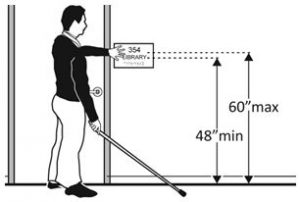 blind to locate them. The signs must be installed 48” minimum from the baseline to the lower raised character and 60” maximum
from the baseline of the highest raised character
blind to locate them. The signs must be installed 48” minimum from the baseline to the lower raised character and 60” maximum
from the baseline of the highest raised character
- There are four recognized symbols that stand for accessibility:
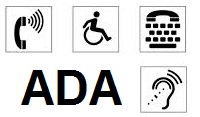
- The International Symbol of Access or “wheelchair symbol”.
- The “Ear Symbol”.
- The “Keyboard Symbol”.
- TTY or “Text Telephon
Note: For complete guidelines please see ANSI AD
While these regulations can appear to be intimidating, fear not, your sign professional will be there every step of the way to guide you through the process. There are also many standard sign designs that cover the majority of your ADA signage needs.