 When Steady Stops Feeling Automatic
Most people do not think about balance until something makes them think about it.
A near miss on the stairs. An ankle that rolled on flat ground for no obvious reason. A knee that buckled slightly while getting off the couch. Nothing serious enough to call a doctor about. Just enough to notice.
That noticing tends to grow. The hesitation before stepping off a curb. The hand reaching for the wall in the dark. The way a walk on uneven ground in Goodyear now requires actual concentration. It gets factored into daily life quietly, long before anyone brings it up to a provider.
What Is Actually Behind It
Joints send constant signals to the brain about position and load. Muscles read those signals and make small adjustments in real time. When a joint is injured, degenerates, or undergoes surgery, those signals are disrupted. The muscle response slows. The adjustments come late or not at all.
Ankle sprains that never fully rehabbed are a common culprit. The ligament healed, but the joint's ability to sense its own position did not come back properly. Knee osteoarthritis does something similar. So does hip degeneration. The joint changes and the whole system around it get less reliable.
A lot of patients dealing with this have an old injury somewhere in their history. One that felt fine for years until it did not.
What Orthopedic Treatment Is Actually Looking At
The first question is where the system is breaking down.
- Is degeneration in the joint reducing the quality of signals being sent to the brain?
- Is muscle weakness leaving the joint without enough support during movement?
- Is there a compensation pattern the body picked up after an old injury that is now creating instability somewhere else entirely?
Each answer points to a different plan. Retraining proprioception in a chronically unstable ankle looks nothing like stabilization work around a knee with early arthritis. A hip that never fully recovered from a replacement needs a different starting point than a healthy joint with weak surrounding muscles.
What the Work Actually Looks Like
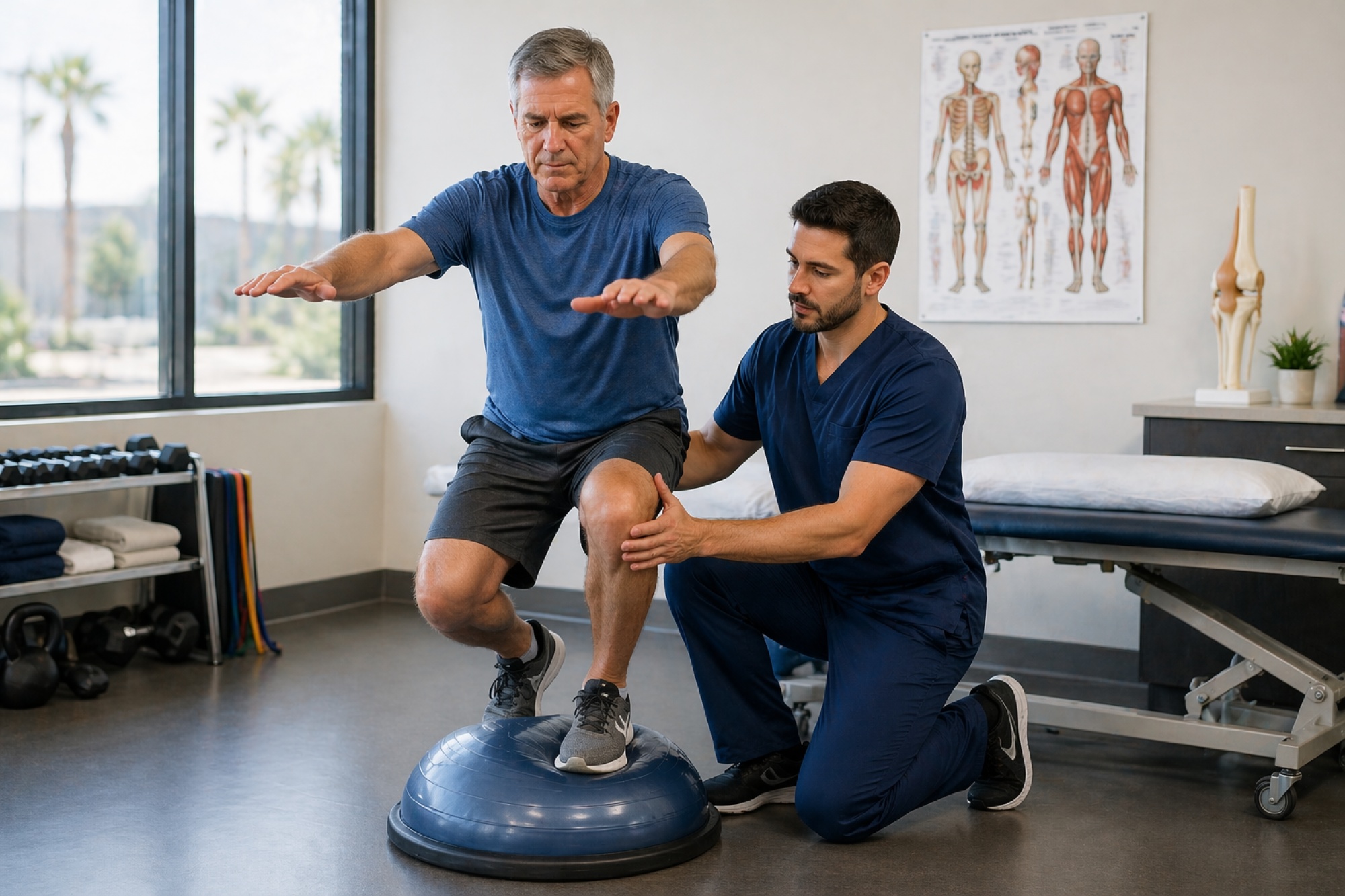
Not glamorous. Single leg standing. Weight shifting. Step training on different surfaces. Resistance work targeting the specific muscles that support the joint when it is under real load.
It builds slowly on purpose. The system has to be challenged enough to adapt. Push it too hard, too fast and it just fails repeatedly, which does not help anything. The progression is the point.
Manual therapy may come into it. Joint injections sometimes play a role if degeneration or inflammation is dulling the signals the joint sends. The physical work and the medical side often overlap, depending on what the joint actually needs right now.
What Actually Changes
It is gradual. Stairs start feeling more controlled. Walking on gravel or grass stops demanding full concentration. Getting up from a low chair stops feeling like something to think through first.
For older local residents, that matters a lot. Falls are one of the more serious and preventable health risks for people over sixty. For younger patients, it means getting back to hiking or playing weekend sports without the knee or ankle feeling like the weak link every single time.
It Is Worth Addressing Before Something Goes Wrong
Joints that feel unstable get loaded unevenly over time. The surrounding muscles weaken further. The risk of a fall or a bad injury climbs.
Contact Modern Medicine of Mesa, AZ, today and let us help you move better.