
The history of ergonomics is quite interesting. From the earliest time, we humans have selected objects we found in the environment and uncovered ways to use them as tools or weapons. Items such as a fist-sized rock became the perfect tool for pounding and other items such as a long sharp piece of wood made workable spears for hunting. Early man then began shaping and altering those objects with the purpose of better utility and fit for both the human and the task at hand. Using materials that were lighter such as antelope hones were scooped out out or sharpened to top a spear.
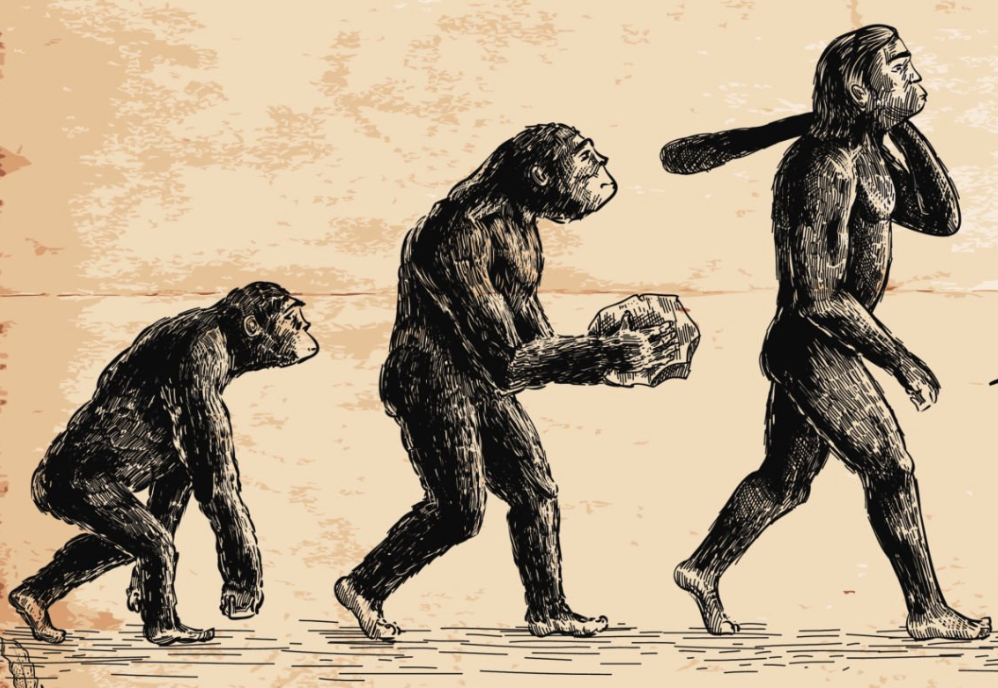
Eventually humans figured out how to create products from raw materials. These products were manufactured to meet a specific need or to perform a task at hand. This over time eventually modernized as we look to the more recent Industrial Revolution where machines such as spinning jennies produced yarn or rolling mills which flattened iron ore into sheets, were developed to signifantly improve our daily lives. The work flow improved even more over time and output kept increasing which led to the construction of tools, homes, and other manufacturing to be all human engineering based activities.
The Roman Empire employed, through trial and error, a principle of training and adapting the physiological capabilities of the recruits to the physical requirements of warfare. As the recruits no longer exhibited sweat on their skin when they were "dry" they wore fit. We now have much more sophisticated and high tech ways and rules for measuring fitness for duty but the basic concept of observing humans and designing systems around them is fundamentally the same.
Most psychologists around the 1900s deliberately avoided looking at problems that strayed outside the boundaries of pure research. Some investigators, however, had practical concerns such as sending and receiving Morse code, measuring perception and attention at work, using psychology in advertising, and promoting industrial efficiency. A particularly important step was the development of "intelligence testing" used to screen military recruits during the First World War and, later, to screen industrial workers for jobs deemed appropriate for their mental capabilities. The terms "intelligence testing" and "industrial psychology" won acceptance.
The field of ergonomics continues to grow and change, driven by new technologies and resulting new jobs and tasks for people. Many sciences provide the fundamental information we need to establish evolving ergonomic guidelines. Sciences including: anthropological understanding relies on anatomy, orthopedics, physiology, medicine, psychology, and even sociology. The engineering side of it uses: physics, chemistry, statistics, and mathematical modeling.
Nowadays we apply ergonomics to AI to assist with understanding the human interactions with computers. We really have come a long way. If you are looking for a local ergonomic specialists or consultant to perform ergonomic evaluations, call Ergobility today.