
 Ergonomics is part of safe patient handling. To get a good grasp on this in the healthcare setting, it is a good idea to both build a relationship with a patient handling equipment vendor and have an ergonomic specialist onboard to navigate the needs and build out engineering controls of the risks. The ergonomics program needs to be robust involving new employee orientation involving teachings on the use of the patient handling equipment and on the job ergonomics training to ensure that workers are following the implemented solutions.
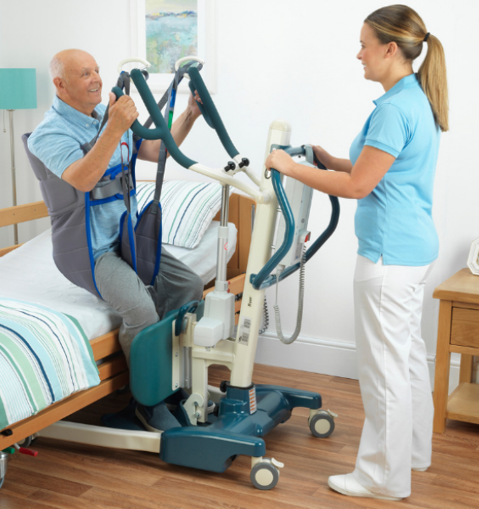
Patients of various mobility will require more than one solution. Some equipment is mean to bring patients from a seated to standing position, some turn them over on one side. Some help with a lateral transfer or lifting them horizontally from levels. As they are eventually ambulated, the recovery is a slow and variable process filled with unpredictable outcomes. It is important that training is built in on effective patient mobility assessments. These are the ways that your healthcare business that avoid costly worker's compensation injuries.
So ensure that your nurses and other healthcare workers are free from harm by having an ergonomic specialist or ergonomic consultant to help your healthcare business navigate the world of patient handling equipment. They should develop relationships with vendors of equipment and assess what is needed to prevent worker back and shoulder injuries that are common in the industry. If you need an ergonomics consultant, call Ergobility today.
Ergonomics is part of safe patient handling. To get a good grasp on this in the healthcare setting, it is a good idea to both build a relationship with a patient handling equipment vendor and have an ergonomic specialist onboard to navigate the needs and build out engineering controls of the risks. The ergonomics program needs to be robust involving new employee orientation involving teachings on the use of the patient handling equipment and on the job ergonomics training to ensure that workers are following the implemented solutions.
Patients of various mobility will require more than one solution. Some equipment is mean to bring patients from a seated to standing position, some turn them over on one side. Some help with a lateral transfer or lifting them horizontally from levels. As they are eventually ambulated, the recovery is a slow and variable process filled with unpredictable outcomes. It is important that training is built in on effective patient mobility assessments. These are the ways that your healthcare business that avoid costly worker's compensation injuries.
So ensure that your nurses and other healthcare workers are free from harm by having an ergonomic specialist or ergonomic consultant to help your healthcare business navigate the world of patient handling equipment. They should develop relationships with vendors of equipment and assess what is needed to prevent worker back and shoulder injuries that are common in the industry. If you need an ergonomics consultant, call Ergobility today.
Fremont, CA - Safe Patient Handling Ergonomics and Lift Equipment Healthcare
SYNOPSIS: Patient handling is the primary cause of back and shoulder pain in healthcare workers. Nurses and patient care technicians need to understand the 35-pound limit for manually lifting patients.
Ergonomics to avoid patient handling injuries.
BY: Allen Yagjian, Ergobility LLC
The National Institute of Occupational Safety and Health (NIOSH) provides guidance on lifting based on various factors that influence the body's capacity to lift safely. Studies have shown that 51 pounds is the maximum lift for a single person with ideal conditions. However, most lifts are far from ideal. In relation to patient handling on the other hand, that maximum is suggested to be only 35 pounds. The load is significantly reduced since lifting patients without lift assist devices is inherently risky since the mobility of the patient is subjective and somewhat unpredictable. For instance, when patients come out of surgery in the post-anesthesia care unit (PACU), they are waking up. During this close observation, the patient can vary in awareness and cognition. This variability means that the patient can be expected to possibly lift their weight but then may begin to fall. Healthcare practitioners caring for patients will have the tendency to catch the patient's fall. During this process it is likely the healthcare worker can injure themselves.
Ergonomics is part of safe patient handling. To get a good grasp on this in the healthcare setting, it is a good idea to both build a relationship with a patient handling equipment vendor and have an ergonomic specialist onboard to navigate the needs and build out engineering controls of the risks. The ergonomics program needs to be robust involving new employee orientation involving teachings on the use of the patient handling equipment and on the job ergonomics training to ensure that workers are following the implemented solutions.
Patients of various mobility will require more than one solution. Some equipment is mean to bring patients from a seated to standing position, some turn them over on one side. Some help with a lateral transfer or lifting them horizontally from levels. As they are eventually ambulated, the recovery is a slow and variable process filled with unpredictable outcomes. It is important that training is built in on effective patient mobility assessments. These are the ways that your healthcare business that avoid costly worker's compensation injuries.
So ensure that your nurses and other healthcare workers are free from harm by having an ergonomic specialist or ergonomic consultant to help your healthcare business navigate the world of patient handling equipment. They should develop relationships with vendors of equipment and assess what is needed to prevent worker back and shoulder injuries that are common in the industry. If you need an ergonomics consultant, call Ergobility today.
Ergonomics is part of safe patient handling. To get a good grasp on this in the healthcare setting, it is a good idea to both build a relationship with a patient handling equipment vendor and have an ergonomic specialist onboard to navigate the needs and build out engineering controls of the risks. The ergonomics program needs to be robust involving new employee orientation involving teachings on the use of the patient handling equipment and on the job ergonomics training to ensure that workers are following the implemented solutions.
Patients of various mobility will require more than one solution. Some equipment is mean to bring patients from a seated to standing position, some turn them over on one side. Some help with a lateral transfer or lifting them horizontally from levels. As they are eventually ambulated, the recovery is a slow and variable process filled with unpredictable outcomes. It is important that training is built in on effective patient mobility assessments. These are the ways that your healthcare business that avoid costly worker's compensation injuries.
So ensure that your nurses and other healthcare workers are free from harm by having an ergonomic specialist or ergonomic consultant to help your healthcare business navigate the world of patient handling equipment. They should develop relationships with vendors of equipment and assess what is needed to prevent worker back and shoulder injuries that are common in the industry. If you need an ergonomics consultant, call Ergobility today.