
In today's modern world, computers have become an integral part of our daily lives. From students to professionals, we spend a significant amount of time sitting at our computer workstations. However, prolonged sitting can have detrimental effects on our health, including discomfort in the back, neck, and shoulders,. Therefore, it is essential to maintain a proper seated position while working at a computer workstation.
The initial step to maintaining a proper seated position is to ensure that the chair is adjusted to the correct height. The chair's height should be such that the heels of your feet are planted on the floor, and your knees bent at a 90-degree angle. This helps to distribute your body weight evenly, reducing the strain on your lower back and legs. Additionally, if the chair has armrests, they should be adjusted to a height where your shoulders can relax, and your elbows rest comfortably.
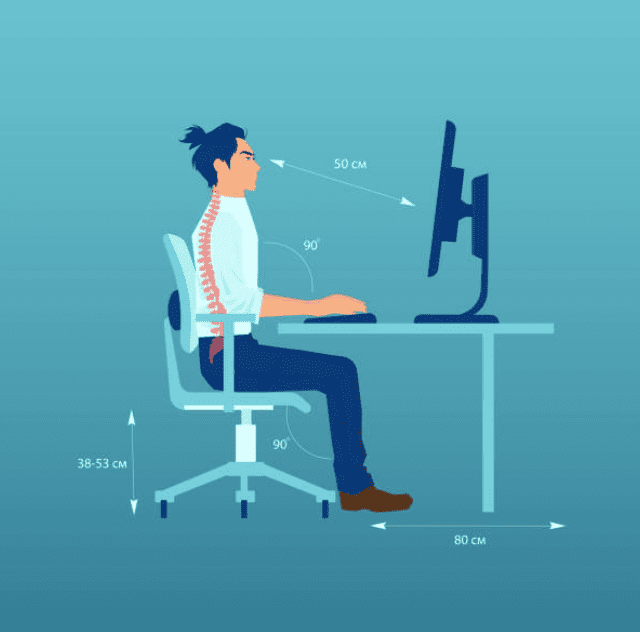 The next step is to adjust the monitor's height and position. The top of the monitor should be at or slightly below eye level, and the distance between the monitor and your eyes should be about an arm's length away. This helps to neck awkward postures caused by looking up or down at the screen. If you wear bifocals, you should have the monitor even lower to avoid tilting your head back.
When typing, your wrists should be in a neutral position, and your forearms should be parallel to the floor. This helps to reduce the strain on your wrists and prevent carpal tunnel syndrome. To achieve this, you may need to adjust the keyboard's height or make use of a keyboard tray.
In addition to these adjustments, it is critical to take frequent short breaks and stretch periodically. Sitting in one position for an extended period can cause muscle fatigue and discomfort. Therefore, taking a one to two minute micro-break every 30 minutes to stand up and stretch can help to alleviate these symptoms. Additionally, exercises such as neck rotations, shoulder shrugs, and wrist flexions can help to reduce tension and improve circulation.
In conclusion, maintaining a proper seated position at a computer workstation is essential for our overall health and well-being. By adjusting the chair, monitor, and keyboard to the correct height and taking periodic breaks and stretches, we can reduce the risk of back pain, neck pain, and poor posture. Remember, our bodies are not designed to sit for long periods, so taking care of ourselves while we work is crucial.
The next step is to adjust the monitor's height and position. The top of the monitor should be at or slightly below eye level, and the distance between the monitor and your eyes should be about an arm's length away. This helps to neck awkward postures caused by looking up or down at the screen. If you wear bifocals, you should have the monitor even lower to avoid tilting your head back.
When typing, your wrists should be in a neutral position, and your forearms should be parallel to the floor. This helps to reduce the strain on your wrists and prevent carpal tunnel syndrome. To achieve this, you may need to adjust the keyboard's height or make use of a keyboard tray.
In addition to these adjustments, it is critical to take frequent short breaks and stretch periodically. Sitting in one position for an extended period can cause muscle fatigue and discomfort. Therefore, taking a one to two minute micro-break every 30 minutes to stand up and stretch can help to alleviate these symptoms. Additionally, exercises such as neck rotations, shoulder shrugs, and wrist flexions can help to reduce tension and improve circulation.
In conclusion, maintaining a proper seated position at a computer workstation is essential for our overall health and well-being. By adjusting the chair, monitor, and keyboard to the correct height and taking periodic breaks and stretches, we can reduce the risk of back pain, neck pain, and poor posture. Remember, our bodies are not designed to sit for long periods, so taking care of ourselves while we work is crucial.
The next step is to adjust the monitor's height and position. The top of the monitor should be at or slightly below eye level, and the distance between the monitor and your eyes should be about an arm's length away. This helps to neck awkward postures caused by looking up or down at the screen. If you wear bifocals, you should have the monitor even lower to avoid tilting your head back.
When typing, your wrists should be in a neutral position, and your forearms should be parallel to the floor. This helps to reduce the strain on your wrists and prevent carpal tunnel syndrome. To achieve this, you may need to adjust the keyboard's height or make use of a keyboard tray.
In addition to these adjustments, it is critical to take frequent short breaks and stretch periodically. Sitting in one position for an extended period can cause muscle fatigue and discomfort. Therefore, taking a one to two minute micro-break every 30 minutes to stand up and stretch can help to alleviate these symptoms. Additionally, exercises such as neck rotations, shoulder shrugs, and wrist flexions can help to reduce tension and improve circulation.
In conclusion, maintaining a proper seated position at a computer workstation is essential for our overall health and well-being. By adjusting the chair, monitor, and keyboard to the correct height and taking periodic breaks and stretches, we can reduce the risk of back pain, neck pain, and poor posture. Remember, our bodies are not designed to sit for long periods, so taking care of ourselves while we work is crucial.
To be sure that your computer workstation is setup ergonomically, call ERGOBILITY today to schedule an appointment with our specialist!