 The tire tech pulls your front wheels during a rotation and calls you over to the lift. The outer tread looks fine from where you've been glancing at it in the driveway for months. But the inner edge of both front tires is shaved down to the wear bars, and one of them is showing cords. You had the alignment done fewer than 10,000 miles ago at a shop in Fremont, and the printout came back green across every angle. Something changed between that printout and today, and it's bolted to the front suspension behind the wheel.
The Bushing That Moves When You Brake
BMW 3 Series models on the E90 platform (2006 through 2011) and F30 platform (2012 through 2018) use a front thrust arm with a fluid-filled hydraulic bushing at its mounting point. That bushing absorbs road vibration and allows controlled flex during cornering, and it's engineered to last the first 60,000 to 80,000 miles without issue. After that mileage threshold, the internal rubber membrane containing the hydraulic fluid tears, the fluid drains into the boot, and the bushing loses its structural integrity. The thrust arm can now shift forward under braking and rearward under acceleration, moving the wheel's contact patch out of the alignment window set when the car was static on the rack.
Why a Fresh Alignment Doesn't Solve It
An alignment machine measures suspension geometry with the car sitting still on a level surface with no forces acting on the wheels. The technician adjusts caster, camber, and toe to factory specifications, prints the sheet, and sends the car out. Every measurement on that printout is accurate for the moment it was taken. The problem is that a torn thrust arm bushing holds position at rest and moves under load. As soon as the driver hits the brakes on Stevenson Boulevard, the wheel shifts, the toe angle changes by a degree or more, and the inner tread edge drags against the pavement at an angle the alignment machine never saw. This cycle repeats thousands of times per week, and the rubber grinds away in a strip the driver can't see from the side of the car.
What a Torn Bushing Looks Like Up Close
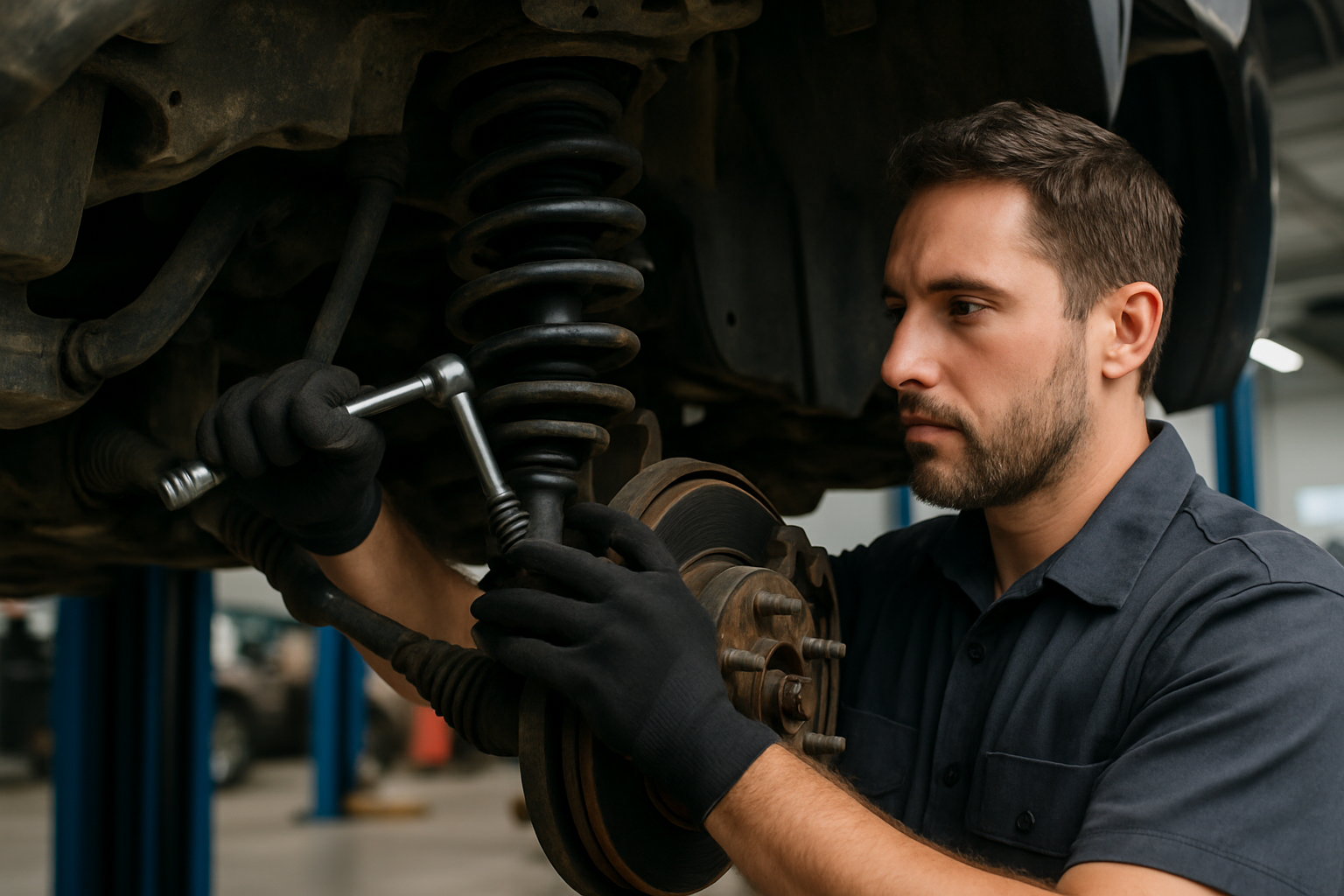
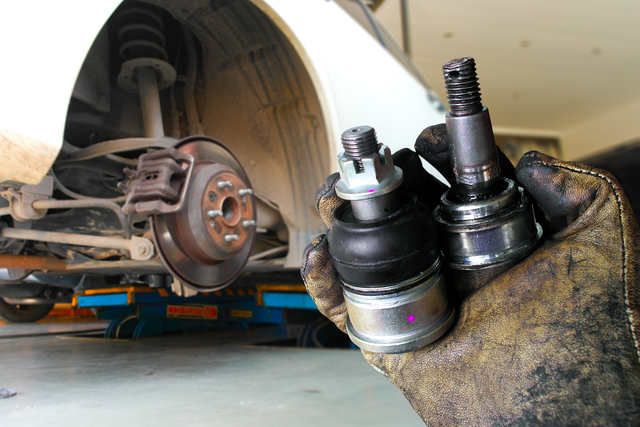
The fluid-filled bushing sits inside a rubber boot at the forward mounting point of the thrust arm. When the internal membrane tears, the silicone fluid migrates out and collects inside the boot, creating a visible bulge or wet sheen on the rubber surface. We inspect this boot with the car on the lift and the front wheels hanging, looking for fluid residue and checking for lateral play by pushing and pulling the arm by hand. A fresh bushing resists movement in every direction. A failed one lets the arm rock with almost no resistance, and you can watch the wheel shift position as the arm moves.
The Measurement That Confirms the Failure
We mount a dial indicator to the steering knuckle and apply force to the thrust arm in the fore-aft direction, measuring deflection in thousandths of an inch. This test quantifies how much the wheel can move under braking and acceleration loads, and it tells us whether the bushing has enough integrity to hold an alignment or whether the arm needs to come out. We replace the control arm as a complete assembly because the bushing is pressed into the arm at the factory and can't be reliably serviced separately on these platforms.
Before You Buy Another Set of Front Tires
The next alignment and the next set of tires will follow the same pattern if the thrust arm bushing underneath is still torn. Driven Auto Care in Fremont catches this failure on BMW 3 Series models with a lift inspection and dial indicator test that takes minutes to perform. Save yourself the cost of another set of front tires by calling (510) 270-3686 and getting the bushing checked before the new rubber goes on.
The tire tech pulls your front wheels during a rotation and calls you over to the lift. The outer tread looks fine from where you've been glancing at it in the driveway for months. But the inner edge of both front tires is shaved down to the wear bars, and one of them is showing cords. You had the alignment done fewer than 10,000 miles ago at a shop in Fremont, and the printout came back green across every angle. Something changed between that printout and today, and it's bolted to the front suspension behind the wheel.
The Bushing That Moves When You Brake
BMW 3 Series models on the E90 platform (2006 through 2011) and F30 platform (2012 through 2018) use a front thrust arm with a fluid-filled hydraulic bushing at its mounting point. That bushing absorbs road vibration and allows controlled flex during cornering, and it's engineered to last the first 60,000 to 80,000 miles without issue. After that mileage threshold, the internal rubber membrane containing the hydraulic fluid tears, the fluid drains into the boot, and the bushing loses its structural integrity. The thrust arm can now shift forward under braking and rearward under acceleration, moving the wheel's contact patch out of the alignment window set when the car was static on the rack.
Why a Fresh Alignment Doesn't Solve It
An alignment machine measures suspension geometry with the car sitting still on a level surface with no forces acting on the wheels. The technician adjusts caster, camber, and toe to factory specifications, prints the sheet, and sends the car out. Every measurement on that printout is accurate for the moment it was taken. The problem is that a torn thrust arm bushing holds position at rest and moves under load. As soon as the driver hits the brakes on Stevenson Boulevard, the wheel shifts, the toe angle changes by a degree or more, and the inner tread edge drags against the pavement at an angle the alignment machine never saw. This cycle repeats thousands of times per week, and the rubber grinds away in a strip the driver can't see from the side of the car.
What a Torn Bushing Looks Like Up Close
The fluid-filled bushing sits inside a rubber boot at the forward mounting point of the thrust arm. When the internal membrane tears, the silicone fluid migrates out and collects inside the boot, creating a visible bulge or wet sheen on the rubber surface. We inspect this boot with the car on the lift and the front wheels hanging, looking for fluid residue and checking for lateral play by pushing and pulling the arm by hand. A fresh bushing resists movement in every direction. A failed one lets the arm rock with almost no resistance, and you can watch the wheel shift position as the arm moves.
The Measurement That Confirms the Failure
We mount a dial indicator to the steering knuckle and apply force to the thrust arm in the fore-aft direction, measuring deflection in thousandths of an inch. This test quantifies how much the wheel can move under braking and acceleration loads, and it tells us whether the bushing has enough integrity to hold an alignment or whether the arm needs to come out. We replace the control arm as a complete assembly because the bushing is pressed into the arm at the factory and can't be reliably serviced separately on these platforms.
Before You Buy Another Set of Front Tires
The next alignment and the next set of tires will follow the same pattern if the thrust arm bushing underneath is still torn. Driven Auto Care in Fremont catches this failure on BMW 3 Series models with a lift inspection and dial indicator test that takes minutes to perform. Save yourself the cost of another set of front tires by calling (510) 270-3686 and getting the bushing checked before the new rubber goes on.
Fremont, CA - BMW Control Arm Wear Leading to Tire Damage? Auto Repair Shop
SYNOPSIS: Driven Auto Care of Fremont explains how thrust arm bushing failure on BMW E90 and F30 models causes inner-edge tire wear even after a recent alignment. A new alignment will not fix it.
New BMW Tires Worn on the Inside Already?
BY: Arun Coumar, Driven Auto Care of Fremont, CA
The tire tech pulls your front wheels during a rotation and calls you over to the lift. The outer tread looks fine from where you've been glancing at it in the driveway for months. But the inner edge of both front tires is shaved down to the wear bars, and one of them is showing cords. You had the alignment done fewer than 10,000 miles ago at a shop in Fremont, and the printout came back green across every angle. Something changed between that printout and today, and it's bolted to the front suspension behind the wheel.
The Bushing That Moves When You Brake
BMW 3 Series models on the E90 platform (2006 through 2011) and F30 platform (2012 through 2018) use a front thrust arm with a fluid-filled hydraulic bushing at its mounting point. That bushing absorbs road vibration and allows controlled flex during cornering, and it's engineered to last the first 60,000 to 80,000 miles without issue. After that mileage threshold, the internal rubber membrane containing the hydraulic fluid tears, the fluid drains into the boot, and the bushing loses its structural integrity. The thrust arm can now shift forward under braking and rearward under acceleration, moving the wheel's contact patch out of the alignment window set when the car was static on the rack.
Why a Fresh Alignment Doesn't Solve It
An alignment machine measures suspension geometry with the car sitting still on a level surface with no forces acting on the wheels. The technician adjusts caster, camber, and toe to factory specifications, prints the sheet, and sends the car out. Every measurement on that printout is accurate for the moment it was taken. The problem is that a torn thrust arm bushing holds position at rest and moves under load. As soon as the driver hits the brakes on Stevenson Boulevard, the wheel shifts, the toe angle changes by a degree or more, and the inner tread edge drags against the pavement at an angle the alignment machine never saw. This cycle repeats thousands of times per week, and the rubber grinds away in a strip the driver can't see from the side of the car.
What a Torn Bushing Looks Like Up Close
The fluid-filled bushing sits inside a rubber boot at the forward mounting point of the thrust arm. When the internal membrane tears, the silicone fluid migrates out and collects inside the boot, creating a visible bulge or wet sheen on the rubber surface. We inspect this boot with the car on the lift and the front wheels hanging, looking for fluid residue and checking for lateral play by pushing and pulling the arm by hand. A fresh bushing resists movement in every direction. A failed one lets the arm rock with almost no resistance, and you can watch the wheel shift position as the arm moves.
The Measurement That Confirms the Failure
We mount a dial indicator to the steering knuckle and apply force to the thrust arm in the fore-aft direction, measuring deflection in thousandths of an inch. This test quantifies how much the wheel can move under braking and acceleration loads, and it tells us whether the bushing has enough integrity to hold an alignment or whether the arm needs to come out. We replace the control arm as a complete assembly because the bushing is pressed into the arm at the factory and can't be reliably serviced separately on these platforms.
Before You Buy Another Set of Front Tires
The next alignment and the next set of tires will follow the same pattern if the thrust arm bushing underneath is still torn. Driven Auto Care in Fremont catches this failure on BMW 3 Series models with a lift inspection and dial indicator test that takes minutes to perform. Save yourself the cost of another set of front tires by calling (510) 270-3686 and getting the bushing checked before the new rubber goes on.