 Try this on your next drive through Fremont: approach a lane change on I-880 at 60 miles per hour and pay attention to how the body settles after you complete the maneuver. A Honda with healthy front struts shifts its weight, transitions, and levels out within one second. A Honda with worn struts rolls into the turn, hangs there, and takes two or three oscillations to find its center. That lazy, wallowing recovery tells you the damping force inside the front strut assemblies has dropped below the threshold where the chassis can control its own weight transfer.
The 2007 through 2016 CR-V and 2008 through 2017 Accord both run MacPherson front struts, and at Driven Auto Care in Fremont, we evaluate these assemblies with a sequence of driving observations and lift-based measurements that pinpoint whether the strut, the mount, or both need attention.
Braking That Pitches the Hood Down
A MacPherson strut does two jobs at the same time: it damps wheel movement like a shock absorber, and it serves as a structural member that carries the coil spring and holds the wheel in position relative to the body. When the internal piston seal wears, fluid bypasses the compression valving on the down-stroke, and the strut can't resist the weight of the engine shifting forward under braking force. The nose drops further than it should, and the rear of the car lifts. That pitch transfers braking grip to the front tires and unloads the rear, which is the opposite of what balanced braking requires. In wet conditions on Fremont's surface streets, this weight imbalance extends stopping distance and reduces the driver's ability to steer during a hard stop.
The Bounce That Won't Settle
Expansion joints on the I-880 overpass near Automall Parkway send a sharp input into the suspension that a good strut absorbs in a single compression-and-rebound cycle. A worn strut lets the body bounce through two or three cycles before the energy dissipates, because the fluid inside the cylinder can't resist the rebound stroke. The car feels floaty at highway speed, and passengers notice the difference before the driver does because they're not gripping the steering wheel for feedback. We duplicate this input during our test drive and count the oscillation cycles to gauge how far the damping has deteriorated.
What the Dust Boot Hides
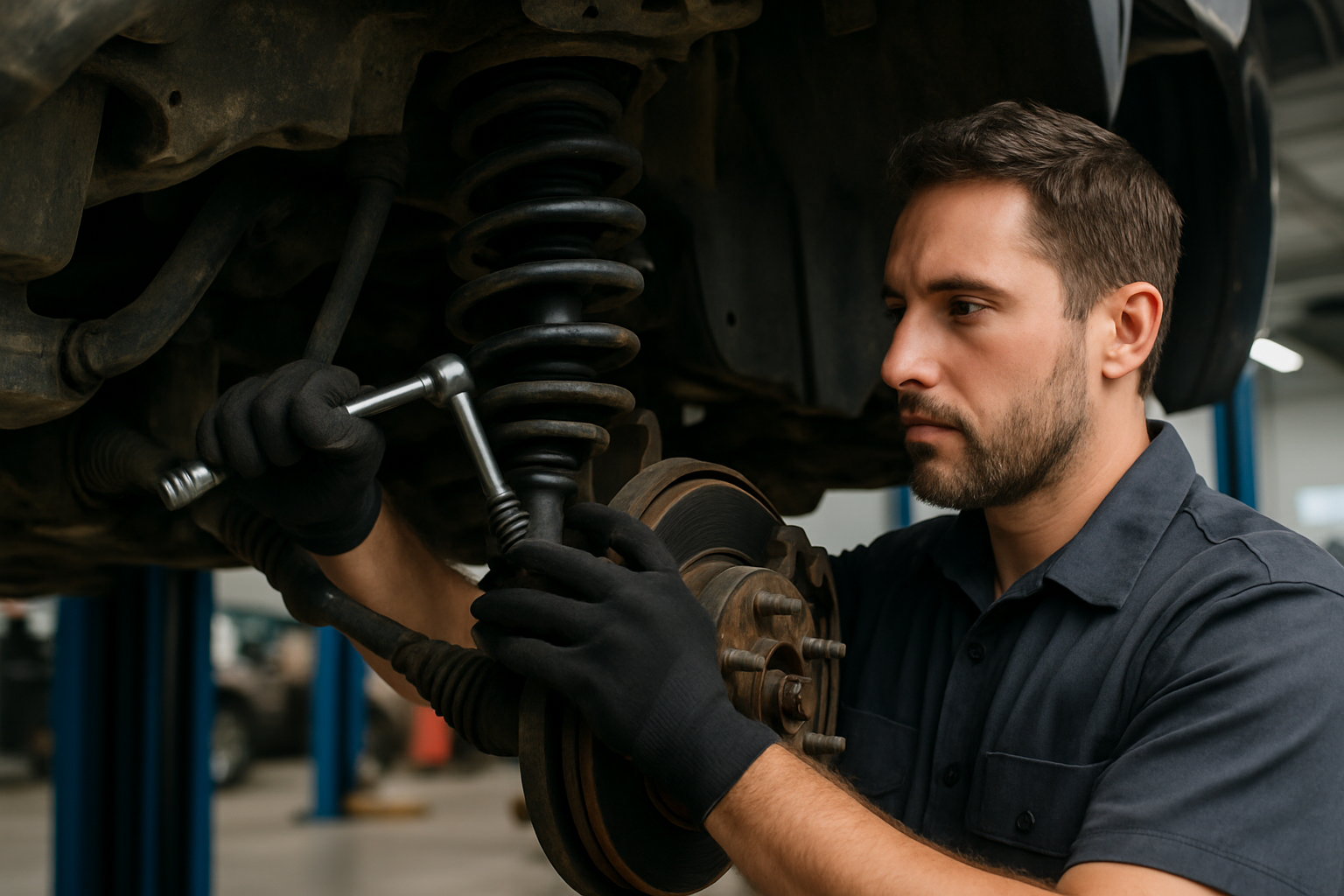
Each front strut has a rubber dust boot that covers the upper section of the strut body where the piston rod enters the cylinder. The boot protects the rod seal from road debris, and it also conceals the earliest evidence of seal failure. We pull the boot back during our lift inspection and check the chrome surface of the piston rod and the upper cylinder wall for oil film. A dry rod surface means the seal is intact. A wet, oily surface below the boot means fluid is migrating past the internal seal, and the strut's damping capacity has already begun to fade.
The Mount Bearing That Wears With the Strut
The upper strut mount sits between the top of the coil spring and the body of the car, and it contains a bearing that allows the strut assembly to rotate when you turn the steering wheel. We hand-rotate this bearing with the spring-loaded on the lift and feel for roughness, grinding, or resistance that indicates the bearing surface has worn. A binding mount bearing adds steering effort and can create a popping sound on full-lock turns in parking lots, and we replace it alongside the strut since the spring has to come off for either repair.
Your Honda Told You on the Freeway
That slow, rolling recovery after a lane change is measurable data about the condition of your front struts, and the article you've been reading explains what each driving symptom means. Driven Auto Care in Fremont tests Honda strut assemblies with a combination of road behavior evaluation and hands-on lift inspection. Reach us at (510) 270-3686 and we'll put the numbers behind what your Honda has been showing you on the road.
Try this on your next drive through Fremont: approach a lane change on I-880 at 60 miles per hour and pay attention to how the body settles after you complete the maneuver. A Honda with healthy front struts shifts its weight, transitions, and levels out within one second. A Honda with worn struts rolls into the turn, hangs there, and takes two or three oscillations to find its center. That lazy, wallowing recovery tells you the damping force inside the front strut assemblies has dropped below the threshold where the chassis can control its own weight transfer.
The 2007 through 2016 CR-V and 2008 through 2017 Accord both run MacPherson front struts, and at Driven Auto Care in Fremont, we evaluate these assemblies with a sequence of driving observations and lift-based measurements that pinpoint whether the strut, the mount, or both need attention.
Braking That Pitches the Hood Down
A MacPherson strut does two jobs at the same time: it damps wheel movement like a shock absorber, and it serves as a structural member that carries the coil spring and holds the wheel in position relative to the body. When the internal piston seal wears, fluid bypasses the compression valving on the down-stroke, and the strut can't resist the weight of the engine shifting forward under braking force. The nose drops further than it should, and the rear of the car lifts. That pitch transfers braking grip to the front tires and unloads the rear, which is the opposite of what balanced braking requires. In wet conditions on Fremont's surface streets, this weight imbalance extends stopping distance and reduces the driver's ability to steer during a hard stop.
The Bounce That Won't Settle
Expansion joints on the I-880 overpass near Automall Parkway send a sharp input into the suspension that a good strut absorbs in a single compression-and-rebound cycle. A worn strut lets the body bounce through two or three cycles before the energy dissipates, because the fluid inside the cylinder can't resist the rebound stroke. The car feels floaty at highway speed, and passengers notice the difference before the driver does because they're not gripping the steering wheel for feedback. We duplicate this input during our test drive and count the oscillation cycles to gauge how far the damping has deteriorated.
What the Dust Boot Hides
Each front strut has a rubber dust boot that covers the upper section of the strut body where the piston rod enters the cylinder. The boot protects the rod seal from road debris, and it also conceals the earliest evidence of seal failure. We pull the boot back during our lift inspection and check the chrome surface of the piston rod and the upper cylinder wall for oil film. A dry rod surface means the seal is intact. A wet, oily surface below the boot means fluid is migrating past the internal seal, and the strut's damping capacity has already begun to fade.
The Mount Bearing That Wears With the Strut
The upper strut mount sits between the top of the coil spring and the body of the car, and it contains a bearing that allows the strut assembly to rotate when you turn the steering wheel. We hand-rotate this bearing with the spring-loaded on the lift and feel for roughness, grinding, or resistance that indicates the bearing surface has worn. A binding mount bearing adds steering effort and can create a popping sound on full-lock turns in parking lots, and we replace it alongside the strut since the spring has to come off for either repair.
Your Honda Told You on the Freeway
That slow, rolling recovery after a lane change is measurable data about the condition of your front struts, and the article you've been reading explains what each driving symptom means. Driven Auto Care in Fremont tests Honda strut assemblies with a combination of road behavior evaluation and hands-on lift inspection. Reach us at (510) 270-3686 and we'll put the numbers behind what your Honda has been showing you on the road.
Fremont, CA - Honda Shocks Causing Rough Ride? Auto Repair Shop Reviews Fix
SYNOPSIS: Driven Auto Care of Fremont explains how worn front struts can cause braking dive, body roll, and bouncing in Honda CR-V and Accord models. Do not wait until your struts give out.
Your Honda Rides Different Now, the Struts Know
BY: Arun Coumar, Driven Auto Care of Fremont, CA
Try this on your next drive through Fremont: approach a lane change on I-880 at 60 miles per hour and pay attention to how the body settles after you complete the maneuver. A Honda with healthy front struts shifts its weight, transitions, and levels out within one second. A Honda with worn struts rolls into the turn, hangs there, and takes two or three oscillations to find its center. That lazy, wallowing recovery tells you the damping force inside the front strut assemblies has dropped below the threshold where the chassis can control its own weight transfer.
The 2007 through 2016 CR-V and 2008 through 2017 Accord both run MacPherson front struts, and at Driven Auto Care in Fremont, we evaluate these assemblies with a sequence of driving observations and lift-based measurements that pinpoint whether the strut, the mount, or both need attention.
Braking That Pitches the Hood Down
A MacPherson strut does two jobs at the same time: it damps wheel movement like a shock absorber, and it serves as a structural member that carries the coil spring and holds the wheel in position relative to the body. When the internal piston seal wears, fluid bypasses the compression valving on the down-stroke, and the strut can't resist the weight of the engine shifting forward under braking force. The nose drops further than it should, and the rear of the car lifts. That pitch transfers braking grip to the front tires and unloads the rear, which is the opposite of what balanced braking requires. In wet conditions on Fremont's surface streets, this weight imbalance extends stopping distance and reduces the driver's ability to steer during a hard stop.
The Bounce That Won't Settle
Expansion joints on the I-880 overpass near Automall Parkway send a sharp input into the suspension that a good strut absorbs in a single compression-and-rebound cycle. A worn strut lets the body bounce through two or three cycles before the energy dissipates, because the fluid inside the cylinder can't resist the rebound stroke. The car feels floaty at highway speed, and passengers notice the difference before the driver does because they're not gripping the steering wheel for feedback. We duplicate this input during our test drive and count the oscillation cycles to gauge how far the damping has deteriorated.
What the Dust Boot Hides
Each front strut has a rubber dust boot that covers the upper section of the strut body where the piston rod enters the cylinder. The boot protects the rod seal from road debris, and it also conceals the earliest evidence of seal failure. We pull the boot back during our lift inspection and check the chrome surface of the piston rod and the upper cylinder wall for oil film. A dry rod surface means the seal is intact. A wet, oily surface below the boot means fluid is migrating past the internal seal, and the strut's damping capacity has already begun to fade.
The Mount Bearing That Wears With the Strut
The upper strut mount sits between the top of the coil spring and the body of the car, and it contains a bearing that allows the strut assembly to rotate when you turn the steering wheel. We hand-rotate this bearing with the spring-loaded on the lift and feel for roughness, grinding, or resistance that indicates the bearing surface has worn. A binding mount bearing adds steering effort and can create a popping sound on full-lock turns in parking lots, and we replace it alongside the strut since the spring has to come off for either repair.
Your Honda Told You on the Freeway
That slow, rolling recovery after a lane change is measurable data about the condition of your front struts, and the article you've been reading explains what each driving symptom means. Driven Auto Care in Fremont tests Honda strut assemblies with a combination of road behavior evaluation and hands-on lift inspection. Reach us at (510) 270-3686 and we'll put the numbers behind what your Honda has been showing you on the road.