 You spent hundreds of dollars on tires eight months ago, and now there's cupping across the tread that shouldn't show up for another three years of Sunol Canyon driving. The tire shop shrugged, mentioned something about a possible defect, and quoted you another four hundred for a new set. At Driven Auto Care in Fremont, CA, we've watched this movie end badly too many times. Those new tires will cup the same way in the same timeframe because the struts underneath your Honda or Acura lost their damping ability somewhere around 85,000 miles, and nobody bothered to check them before selling you rubber that's going to die the same death.
Here's what's actually happening every time you hit a bump. Struts control how fast your wheels move up and down by forcing hydraulic fluid through precision valving inside a sealed tube. When the seals wear and fluid bypasses that valving, the wheel bounces instead of settling quickly. Each bounce lifts the tire off the pavement and slaps it back down, and that repeated slapping scallops the tread into the cupped pattern you're looking at right now. The struts on your Accord, Civic, CR-V, or Pilot wore out slowly enough that you adjusted to the harsher ride without realizing anything broke.
Why The Bounce Test Tells You Nothing Useful
Someone probably pushed down on your fender, watched it bounce twice, and declared your struts fine. That test worked in 1978 when cars had separate springs and simple tube shocks with basic hydraulic valving. Modern struts need to be evaluated under actual driving conditions, where body roll through turns, nose dive during braking, and road surface transitions reveal damping loss that parking lot pushing misses entirely. We drive your Honda over specific routes with expansion joints, surface changes, and bump sequences chosen specifically because they make worn struts obvious to anyone who knows what to feel through the steering wheel and seat.
Mount Bearings Making Noise You Blame On Other Things
The upper strut mounts on Hondas contain bearings that let the assembly rotate when you turn the steering wheel, while also supporting spring compression loads from road impacts. Those bearings dry out and bind after years of exposure to road salt and moisture, producing creaking sounds during parking maneuvers that owners swear must be the steering rack going bad. Civic models from 2012 through 2015 and CR-V from 2012 through 2016 developed this noise pattern earlier than other Honda platforms, possibly from bearing supplier changes during those production runs. When mounts bind and shift, they also affect camber angle in ways alignment adjustment can't permanently correct because the problem isn't in the adjusters.
Rear Shocks Killing Tires Nobody Inspects
Front struts get all the attention because symptoms appear during braking and steering evaluation. Meanwhile, the rear shocks wear out just as completely and contribute equally to tire destruction through identical bouncing and slapping patterns affecting the rear tread. CR-V, Pilot, RDX, and MDX models carrying cargo weight in the back experience accelerated rear shock deterioration that sedan variants don't see at the same mileage. We check rear dampers during every strut evaluation because ignoring them means rear tires cup while everyone celebrates fixing the fronts.
Stop Feeding Tires To Dead Dampers
New tires on worn struts last exactly as long as the old ones did before cupping killed them. Call Driven Auto Care at (510) 270-3686 before you spend another four hundred dollars on rubber that's going to die the same way.
You spent hundreds of dollars on tires eight months ago, and now there's cupping across the tread that shouldn't show up for another three years of Sunol Canyon driving. The tire shop shrugged, mentioned something about a possible defect, and quoted you another four hundred for a new set. At Driven Auto Care in Fremont, CA, we've watched this movie end badly too many times. Those new tires will cup the same way in the same timeframe because the struts underneath your Honda or Acura lost their damping ability somewhere around 85,000 miles, and nobody bothered to check them before selling you rubber that's going to die the same death.
Here's what's actually happening every time you hit a bump. Struts control how fast your wheels move up and down by forcing hydraulic fluid through precision valving inside a sealed tube. When the seals wear and fluid bypasses that valving, the wheel bounces instead of settling quickly. Each bounce lifts the tire off the pavement and slaps it back down, and that repeated slapping scallops the tread into the cupped pattern you're looking at right now. The struts on your Accord, Civic, CR-V, or Pilot wore out slowly enough that you adjusted to the harsher ride without realizing anything broke.
Why The Bounce Test Tells You Nothing Useful
Someone probably pushed down on your fender, watched it bounce twice, and declared your struts fine. That test worked in 1978 when cars had separate springs and simple tube shocks with basic hydraulic valving. Modern struts need to be evaluated under actual driving conditions, where body roll through turns, nose dive during braking, and road surface transitions reveal damping loss that parking lot pushing misses entirely. We drive your Honda over specific routes with expansion joints, surface changes, and bump sequences chosen specifically because they make worn struts obvious to anyone who knows what to feel through the steering wheel and seat.
Mount Bearings Making Noise You Blame On Other Things
The upper strut mounts on Hondas contain bearings that let the assembly rotate when you turn the steering wheel, while also supporting spring compression loads from road impacts. Those bearings dry out and bind after years of exposure to road salt and moisture, producing creaking sounds during parking maneuvers that owners swear must be the steering rack going bad. Civic models from 2012 through 2015 and CR-V from 2012 through 2016 developed this noise pattern earlier than other Honda platforms, possibly from bearing supplier changes during those production runs. When mounts bind and shift, they also affect camber angle in ways alignment adjustment can't permanently correct because the problem isn't in the adjusters.
Rear Shocks Killing Tires Nobody Inspects
Front struts get all the attention because symptoms appear during braking and steering evaluation. Meanwhile, the rear shocks wear out just as completely and contribute equally to tire destruction through identical bouncing and slapping patterns affecting the rear tread. CR-V, Pilot, RDX, and MDX models carrying cargo weight in the back experience accelerated rear shock deterioration that sedan variants don't see at the same mileage. We check rear dampers during every strut evaluation because ignoring them means rear tires cup while everyone celebrates fixing the fronts.
Stop Feeding Tires To Dead Dampers
New tires on worn struts last exactly as long as the old ones did before cupping killed them. Call Driven Auto Care at (510) 270-3686 before you spend another four hundred dollars on rubber that's going to die the same way.
Sunol CA - Auto Shop Offers Honda & Acura Strut Replacement for Uneven Tire Wear
SYNOPSIS: Tire shops blame defects and sell replacements that cup the same way because nobody checked the worn struts underneath. Driven Auto Care of Fremont, CA serves owners with diagnostics for tire wear.
The Truth: Your Tires Didn't Fail, Your Struts Did
BY: Arun Coumar, Driven Auto Care of Fremont, CA
You spent hundreds of dollars on tires eight months ago, and now there's cupping across the tread that shouldn't show up for another three years of Sunol Canyon driving. The tire shop shrugged, mentioned something about a possible defect, and quoted you another four hundred for a new set. At Driven Auto Care in Fremont, CA, we've watched this movie end badly too many times. Those new tires will cup the same way in the same timeframe because the struts underneath your Honda or Acura lost their damping ability somewhere around 85,000 miles, and nobody bothered to check them before selling you rubber that's going to die the same death.
Here's what's actually happening every time you hit a bump. Struts control how fast your wheels move up and down by forcing hydraulic fluid through precision valving inside a sealed tube. When the seals wear and fluid bypasses that valving, the wheel bounces instead of settling quickly. Each bounce lifts the tire off the pavement and slaps it back down, and that repeated slapping scallops the tread into the cupped pattern you're looking at right now. The struts on your Accord, Civic, CR-V, or Pilot wore out slowly enough that you adjusted to the harsher ride without realizing anything broke.
Why The Bounce Test Tells You Nothing Useful
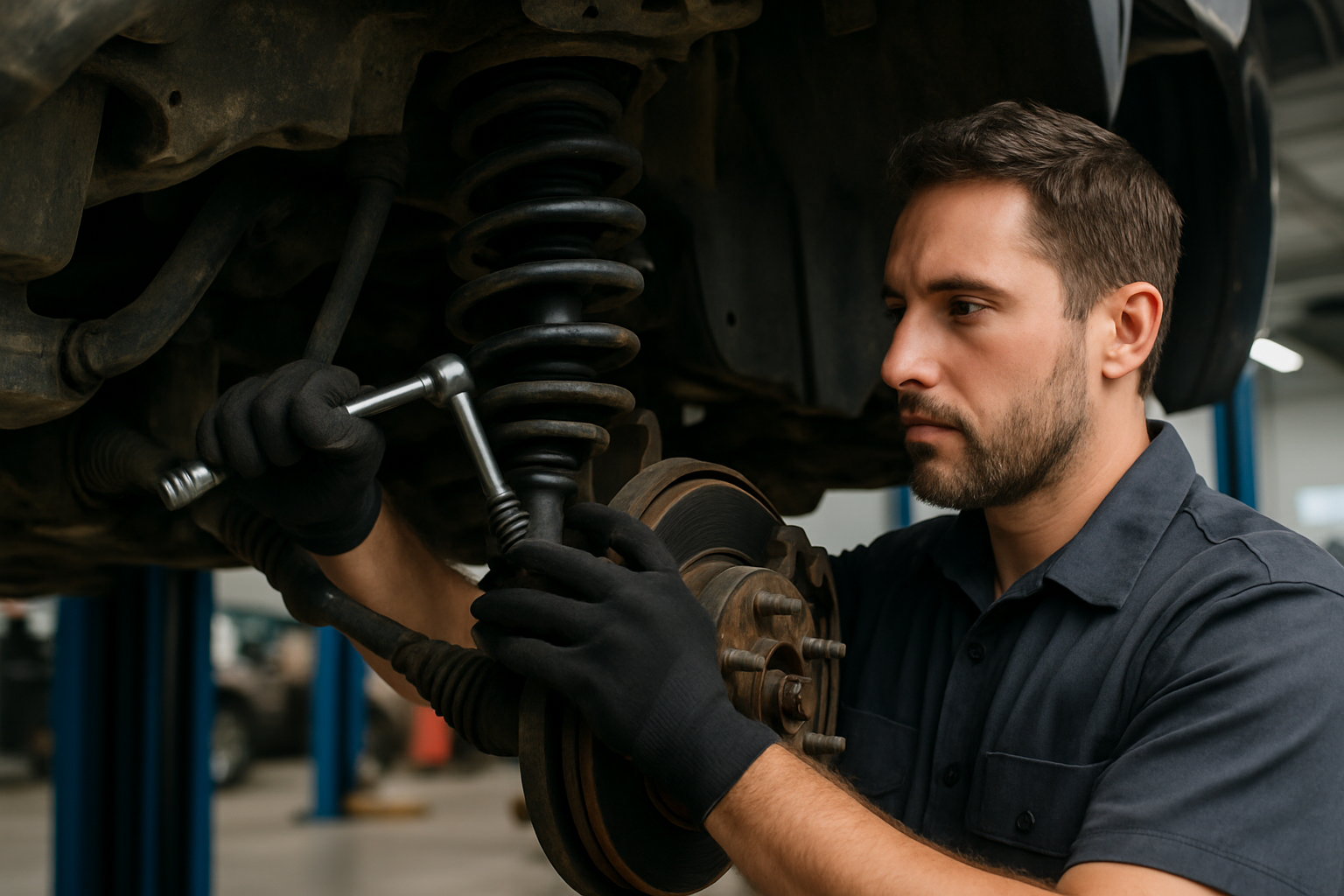
Someone probably pushed down on your fender, watched it bounce twice, and declared your struts fine. That test worked in 1978 when cars had separate springs and simple tube shocks with basic hydraulic valving. Modern struts need to be evaluated under actual driving conditions, where body roll through turns, nose dive during braking, and road surface transitions reveal damping loss that parking lot pushing misses entirely. We drive your Honda over specific routes with expansion joints, surface changes, and bump sequences chosen specifically because they make worn struts obvious to anyone who knows what to feel through the steering wheel and seat.
Mount Bearings Making Noise You Blame On Other Things
The upper strut mounts on Hondas contain bearings that let the assembly rotate when you turn the steering wheel, while also supporting spring compression loads from road impacts. Those bearings dry out and bind after years of exposure to road salt and moisture, producing creaking sounds during parking maneuvers that owners swear must be the steering rack going bad. Civic models from 2012 through 2015 and CR-V from 2012 through 2016 developed this noise pattern earlier than other Honda platforms, possibly from bearing supplier changes during those production runs. When mounts bind and shift, they also affect camber angle in ways alignment adjustment can't permanently correct because the problem isn't in the adjusters.
Rear Shocks Killing Tires Nobody Inspects
Front struts get all the attention because symptoms appear during braking and steering evaluation. Meanwhile, the rear shocks wear out just as completely and contribute equally to tire destruction through identical bouncing and slapping patterns affecting the rear tread. CR-V, Pilot, RDX, and MDX models carrying cargo weight in the back experience accelerated rear shock deterioration that sedan variants don't see at the same mileage. We check rear dampers during every strut evaluation because ignoring them means rear tires cup while everyone celebrates fixing the fronts.
Stop Feeding Tires To Dead Dampers
New tires on worn struts last exactly as long as the old ones did before cupping killed them. Call Driven Auto Care at (510) 270-3686 before you spend another four hundred dollars on rubber that's going to die the same way.