 The 2026 Homeowner’s Roadmap: Maximizing the “My Safe Florida Home” Grant in SWFL
If you own a home in Fort Myers, Naples, or Cape Coral, you’ve likely felt the sting of rising property insurance. In 2026, the conversation in Southwest Florida has shifted from “How do I fix my roof?” to “How do I make my roof pay for itself?”
The My Safe Florida Home (MSFH) program remains the most effective way to bridge that gap. At PRG Roofing & Construction, we’ve guided hundreds of neighbors through this process. Here is your updated strategic guide to securing up to $10,000 in state funding this year.
Why 2026 is the Year to Act
Florida’s building codes are some of the strictest in the world, and for good reason. The MSFH grant isn’t just a handout; it’s an incentive to bring older homes up to High-Velocity Hurricane Zone (HVHZ) standards. By strengthening your roof’s “skeleton,” you aren’t just protecting your family—you’re creating a paper trail that forces insurance companies to lower your premiums.
The Three Pillars of Eligibility
Before the state cuts a check, you must meet these core criteria:
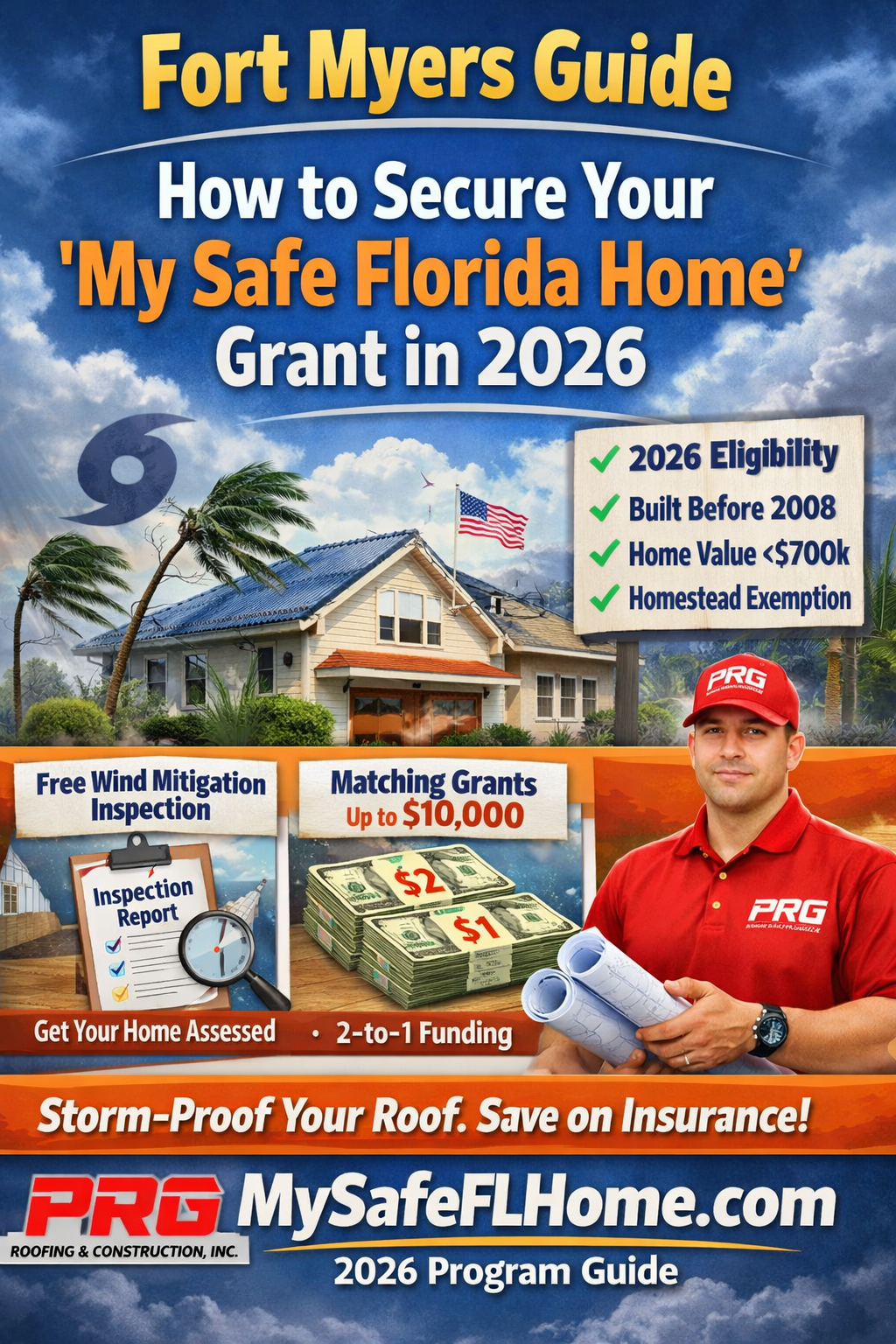
- Homestead Status: The property must be your primary residence with a filed Florida Homestead Exemption.
- The “Age” Factor: Your home must have been permitted for construction before January 1, 2008.
- Insured Value: The dwelling coverage (Coverage A) on your policy must be $700,000 or less (unless you qualify under low-income brackets).
The Step-by-Step Execution Plan
- Step 1: The Wind Mitigation Inspection — The process begins at mysafeflhome.com. You must apply for a state-funded inspection. A certified inspector will evaluate your roof’s “weak points,” such as the nail spacing on your roof deck and the presence (or lack) of a Secondary Water Barrier (SWR).
- Step 2: The Approval Wait — Crucial Tip: Do not sign a contract with a roofer until you have your Grant Approval Letter in hand. The state is strict—any work started or contracted before the official approval date is ineligible for reimbursement.
- Step 3: Selecting a “Grant-Literate” Contractor — Not all roofers understand the documentation required by the MSFH program. At PRG Roofing, we provide the specific photo evidence and line-item invoicing the state requires to process your claim quickly. We focus on the “Big Three” upgrades:
- Enhanced Roof-to-Wall Connections: Strengthening where the roof meets the house.
- SWR (Secondary Water Resistance): An extra layer of protection that keeps water out even if shingles blow off.
- Upgraded Roof Decking Fasteners: Replacing old staples or short nails with 8d ring-shank nails.
The Financial Breakdown: The 2-to-1 Match
The program typically operates as a matching grant. For every $1 you contribute toward the qualifying hurricane-resistant portions of your roof, the state contributes $2, maxing out at $10,000.
Example: If your qualifying upgrades cost $15,000, you pay $5,000 and the state covers $10,000.
Final Thoughts from the PRG Team
Investing in your roof in 2026 is about more than just aesthetics—it’s about financial resilience. Between the MSFH grant and the subsequent “Wind Mitigation Credits” on your insurance, the ROI on a new PRG roof has never been higher.
Stop guessing and start hardening your home. If you have questions about your inspection report or want a detailed quote for an HVHZ-compliant roof, call the PRG Roofing & Construction team at (239) 237-2906.