 Tap the brakes heading down Crow Canyon Road in San Ramon and notice whether the steering wheel shakes side to side under pedal pressure, because that shimmy tells you the front rotors have developed lateral runout beyond their tolerance. Hit a speed bump on Bollinger Canyon and listen for a hollow thud from the front suspension, because that sound points to a thrust arm ball joint with enough play to move under load. BMW engineered the 3 Series and X3 so that brakes and suspension work as one integrated system, and Driven Auto Care of San Ramon measures both before recommending either repair.
Why BMW Front Pads Wear Faster Than Rears
The 3 Series and X3 carry more weight over the front axle than the rear, and BMW’s electronic brake distribution sends a higher percentage of braking force to the front calipers during every stop. Front pads on an F30 3 Series or F25 X3 wear at roughly twice the rate of the rears under mixed city and highway driving conditions in the Tri-Valley. Once the pad material drops below 3mm, the friction surface can’t absorb heat evenly, and the pad backing plate begins to contact the rotor face. That metal-on-metal contact scores grooves into the rotor that no resurfacing pass can remove.
Rotor Runout and What the Dial Indicator Shows
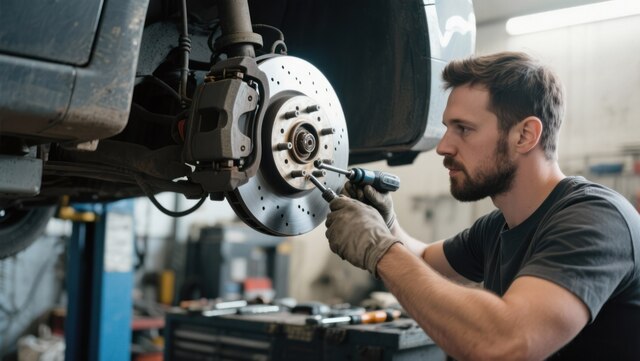
A brake rotor that looks smooth to the eye can still wobble on the hub by a few thousandths of an inch, and that wobble transfers through the caliper into the steering column as a pulsation you feel in your hands. We mount a dial indicator against the rotor face and spin it by hand to measure lateral runout at the friction surface, and any reading beyond the factory threshold means the rotor needs replacement. Runout develops from uneven torque on the wheel bolts, heat cycling that warps the casting, or hub corrosion that prevents the rotor from seating flat against the bearing flange.
The F30 Thrust Arm Ball Joint
The front thrust arm on the F30 3 Series and F25 X3 is the lower forward control arm that locates the front wheel assembly and absorbs braking loads transferred through the knuckle. Its ball joint endures every pothole, expansion joint, and road imperfection at highway speed, and the joint develops play after 60,000 to 80,000 miles of San Ramon and Tri-Valley road surfaces. A worn thrust arm ball joint allows the knuckle to shift under braking and acceleration, changing the toe angle at that corner and creating a pulling sensation through the steering wheel. Inner tire edge wear on one front tire is a visible confirmation that the ball joint has moved past its service limit.
Brakes and Suspension Share a Conversation
Replacing brake pads on a BMW without checking the thrust arms ignores the relationship between the two systems, because a worn ball joint allows the knuckle to move during hard braking and loads the new pads unevenly across the rotor face. We measure pad thickness at all four corners, check rotor runout on each disc, and load-test both front thrust arm ball joints during every BMW brake evaluation at our San Ramon shop. After pad, rotor, or thrust arm replacement, we torque every fastener to the BMW specification and run a four-wheel alignment to confirm the front geometry matches factory camber, caster, and toe settings. The BMW driving feel you paid for starts with components measured to spec, and (925) 830-4701 puts you in touch with Driven Auto Care of San Ramon whenever your 3 Series or X3 needs that feel restored.